
Nappy-free Baby

Put your children on the potty from an early age and your life will be better

Do you want your child to sit in a nappy full of their own faeces? Do you enjoy changing dirty nappies and wiping poo from their bottom, legs and back? Do you think it reasonable to allow your child to soil themselves, rather than to give them the opportunity to relieve themselves in a potty or toilet? If you answered yes to any of the above questions then this article is not for you.

Very young children are capable of holding it until given the opportunity to use a potty, and it is very easy to build this routine into your life. It has lots of benefits and is definitely something you should do.

One to save for her 18th birthday…

Nappy-free baby is a concept I first came across (like so many things) via Kevin Kelly’s Cool Tools (previously featured here). In this case it wasn’t through browsing the Cool Tools catalogue, a large printed book full of recommendations from the website and elsewhere. I highly, highly recommend the catalogue, it’s a few years out-of-date in some areas but browsing through it opens your mind up to all sorts of new opportunities, tools and things that you may not have considered before.

The basic idea is that children do not want to soil themselves, and if you give them the opportunity to poo in a potty then they will do so, rather than in their nappy. The usual advice of waiting until a child is 2 or 3 until trying to introduce the potty is advice that has been promoted by and on behalf of Pampers and similar companies to sell more nappies. Nappies are very good and effective at holding in waste so it is easy and convenient to continue to use them. This is relatively recent advice, since good disposable nappies were invented. Prior to the 1950s, it was usual to encourage young children to use a potty, since it saved on laundry. This approach is still followed in many developing countries.

So nappy-free baby (also known as elimination communication) is the idea that you pay attention to your child and give them opportunities to use a potty at appropriate times. For us, this meant that every few hours we would hold our daughter over the potty. Her very first poo was in an old ice cream tub in hospital when she was a day old. Whenever she woke up from a nap, we would hold her over the potty and change her nappy, whenever we changed her nappy we would hold her over the potty as well. When she seemed fussy but wasn’t hungry or tired, we would hold her over the potty and usually catch a poo. By watching and paying attention to your child, you can recognise the signs that they need a poo and give them the opportunity to do it in a potty, rather than in their clothes.

NB our children still wore nappies all day every day, but most of the time those nappies were completely clean and they were never filled with poo.

This might sound intimidating and a lot of work, but it really isn’t. From about 6 months until they went to nursery, both our children did all their poos in a potty – no filthy nappies, no nappy rash.

One day when our daughter was about two years old, she told us that she didn’t want to wear nappies anymore. We had about a week of accidents where she would wee herself, but she always pooed in a potty or toilet. Then after about a week she was potty trained and out of nappies during the day.

I recommend the book “Nappy-free Baby”, but it’s not really necessary. You need a potty that is suitable for a small child. On eBay you can find lots of child chamber pots from the time before nappies, or you can use a standard plastic potty. You hold your child’s thighs with their back to you and support them in a squat position. That’s about it really. You need to commit to the method for a week or so, but once you start making “catches” and putting clean nappies on your child it’s very rewarding. There are lots of blogs and forums about this, but they can be full of right-on Americans and hippies. Nappy-free baby is not just for hippies, this is the sensible approach to looking after your child that makes both of your lives better and easier.

Data Driven Weight Management

How to manage your weight the fun and easy way – with a spreadsheet

Here is the method that I and others have found to be the most effective for managing your weight, whether you want to lose, maintain or even gain weight. It is a very simple method, but if it fits with your particular mindset and psychology then it works very well. Particularly if you know what is a healthy diet and if you’ve tried calorie counting or other diets in the past.

Weigh yourself every day, and use a spreadsheet to record that weight.

That’s it.

This method takes inspiration from the “Lean Analytics” movement, and in particular the notion of “One Metric that Matters”. If your goal is to lose weight, then weight is the metric that matters and that is what you need to track. Important to acknowledge here that weight is not a perfect indicator of physical health, or athletic performance or attractiveness – but as a metric it has some features that make it very useful:

  1. You can measure it easily and precisely. Buy some bathroom scales, stand on them and write down the number. It takes 5 seconds. Compare this to testing your 5km time, or trying to measure bodyparts or compare photographs.
  2. Because it is so easy to measure, you can do it every day. This gives you instant feedback on the consequences of your actions. You know that eating cheeseburgers and cake will have a negative impact on your progress, but now you will see that immediately, or at least in a day or two. Vice-versa, 2 days of disciplined actions will result in a measurable change in your weight (assuming digital scales in kilograms)

You may say that you don’t actually want to lose weight. What you really want to do is to look better naked, or be able to run quicker or some other underlying goal, so you should be using a mirror or a stopwatch to measure your progress. What I say to this is that you can worry more about that other stuff, once you have your weight in the right area. In my case that means getting down to a healthy BMI. In other people’s case, it’s about getting back to their pre-baby weight.

This method can be intimidating, as it forces you to face the consequences of your actions, but you should realise that this is a good thing. If you find yourself not wanting to record a weight after a particularly heavy weekend, then you should ask yourself how serious you really are about achieving your goal.

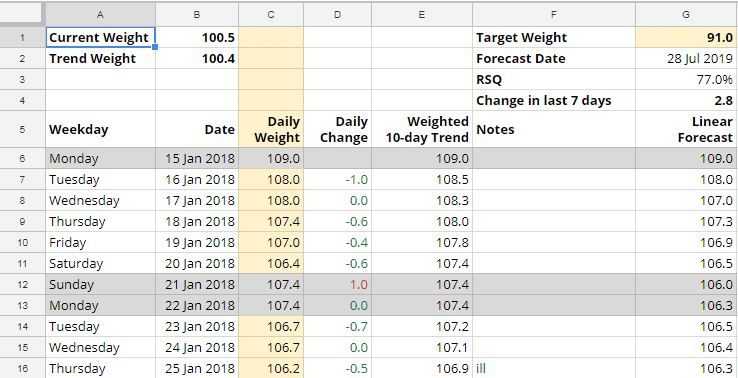
The spreadsheet template will calculate a weighted 10-day average weight, which smooths out some of the natural ups and downs you will experience. Given a target weight, it will calculate when you can expect to hit that target, based on your progress so far. It will also show how consistent you have been in your weight loss (or gain) and the change in the last 7 days.

Here’s the spreadsheet

This is what the spreadsheet looks like

This is a Google spreadsheet and is locked for editing – to use it you’ll need to make a copy of the template you can use. Otherwise you’d be over-writing the template and I would be able to see everything you’re doing. If you have a Google account then sign in to that, make a copy of the template to your own Google Drive and crack on (File >> Make a Copy). If you don’t have a Google account then I recommend getting one just to use Google Drive, but otherwise you can download the template to use in Excel. I have not tested the template in Excel, and recommend using a Google account and Google Sheets. The Google Sheets app for mobile is good and easy to use as well.

You start by entering your target weight in cell G1, in this case my target is 91.0. You also need to enter the date you are starting the plan in cell B6. Then every day you enter your weight in column C and everything else will update automatically. You may want to enter notes in column F to record any reasons for why your daily weight moves.

There’s also a tab with a chart:

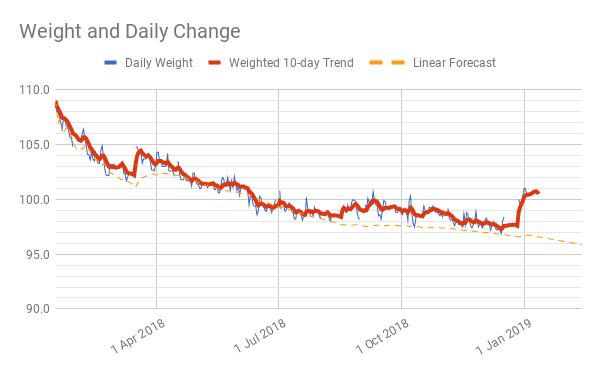
My progress is pretty erratic. Christmas was not a good time for the diet

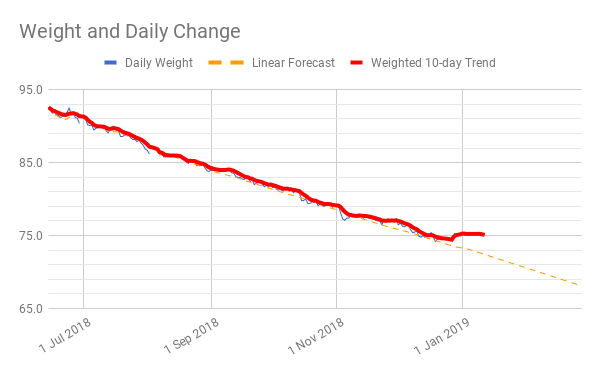
The red line here is the weighted 10-day trend which you can see smooths out a lot of the day-to-day variation and is the line to worry about. In my case I started really well, then went on a work trip to Italy which set me back considerably. Summer I made much slower progress but still progress and now I’m going to have to work off everything I’ve put on over Christmas. I’m confident I’ll get to my target though. Here is the equivalent chart of someone more disciplined than me:

You can’t expect to lose weight at Christmas

I am not a doctor and have no training in nutrition or dietary science, you should eat a balanced diet with lots of vegetables and exercise. But if you are not at a healthy weight, then this is the most effective tool I have found to game your psychology into getting you to a healthy weight. Use at your own risk

Packrafting 6 – Braemar to Balmoral

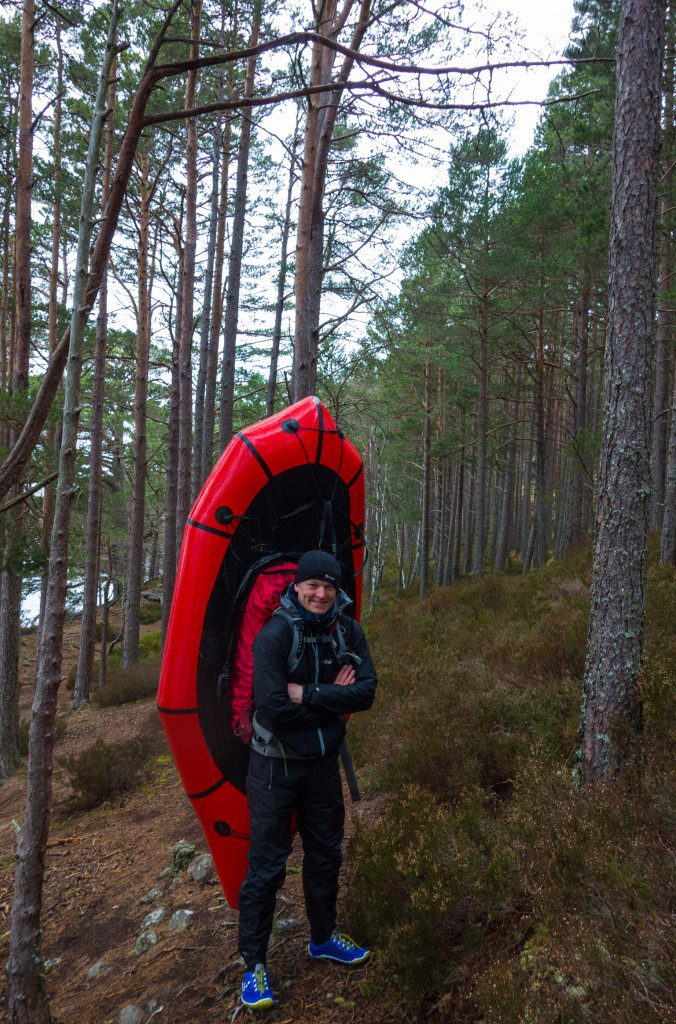
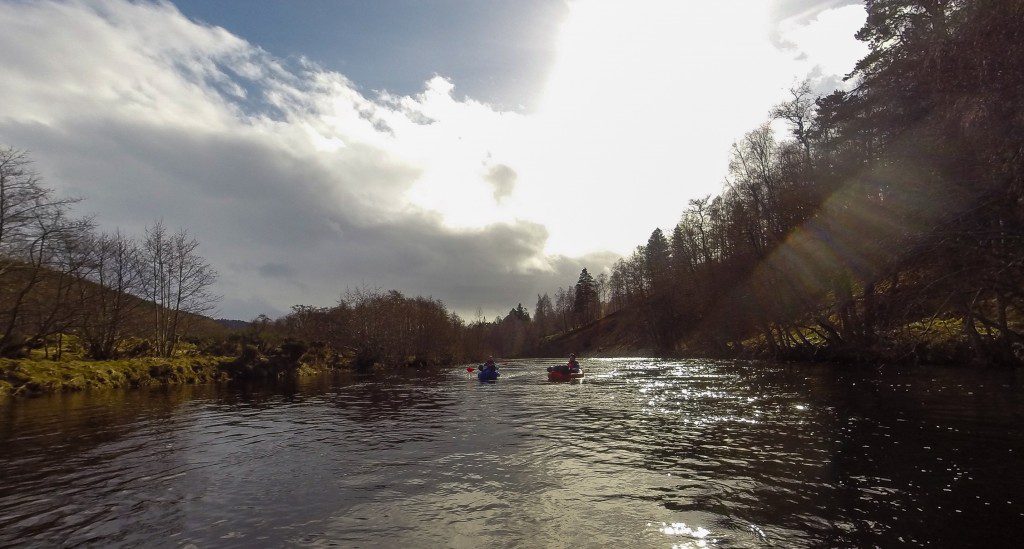
The final day of the trip and the three of us were to be joined by Sarah and Rachel for a bit of rafting down the Dee to see how far we could get. We pushed off early as we due to meet Sarah and Rachel in Braemar and had a pleasant float down before meeting up with the others.

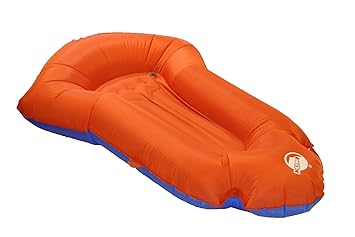
Rachel had hired a packraft for the day but rather than suggesting that Sarah hire one as well I decided to buy a Klymit Litewater Dinghy, reasoning that it cost about the same as renting and I would be able to use it on other trips.

Not really a packraft

The Litewater is very light but probably more of a lilo than a dingy. It has great reviews and in particular this video made it look very capable.

It’s actually a great little boat boat for what it is and it is incredibly lightweight. You will not stay very dry in it though and it is not as fast or as hardwearing as the Alpaca packrafts. I was definitely lagging at the back of the group and having to do a lot of bailing and paddling. It being much more open than the Alpacas made even very mild white water much more interesting as the risk of falling out was very real.

I took a couple of punctures though from running through shallow water, leading to the site of me walking along the bank of a river, wearing waterproofs and a bike helmet, carrying a lilo while someone fished on the other side. I wish I had a picture of that, can’t imagine what the guy was thinking.

After my second puncture I decided to call it a day for the Litewater and let the others go on at a better pace. I packed up the raft and started walking on the road, aiming to hitch a lift to Lochnagar distillery. I managed to pick up a lift after about 30min walking and then had an enjoyable time sitting at the distillery, drinking some whisky and having a look around while waiting for the others. Was also very glad not to have had to carry a raft up the hill from the river. By all accounts the river got a bit more exciting so probably for the best that I bailed when I did, rather than fall out further down. Would recommend the Litewater for still water or canals in good weather when you don’t really mind about getting wet, not so much for actual white water.

This was then the end of the trip, our Dalwhinnie glasses had survived and we managed to get another stamp in the whisky passport. It was a fantastic trip, hard work but a lot of fun. Too many highlights to mention but the first day and night in the bothy was great, getting off the train in the middle of nowhere. Packsledging was a fun innovation, wild camp by the river was lots of fun, massive pub feeds after a day of walking tasted awesome. Need to work out a way to do this again…


Packrafting 5 – Aviemore to Braemar part 2

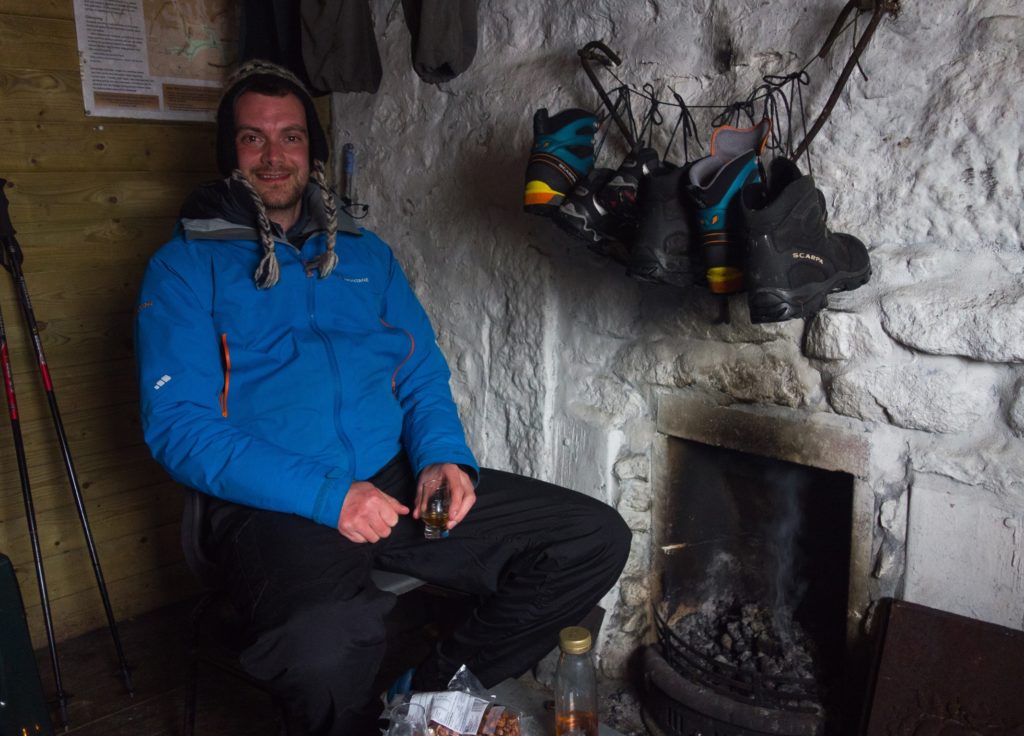
We spent a good night in Corrour bothy, updated the bothy book and drank most of our whisky. Managed to get the scraps of coal lit but Quiller’s plan for drying out our boots proved to be extremely optimistic.

This was completely ineffective. Looked good though

It’s easy to sleep well after a hard day of walking and my body seemed to have got used to the effort as I didn’t have the same level of cramps and aches that I did after day one. We’d also learnt now to hang all our food up out of the reach of mice.

Breakfast was the standard coffee, granola and powdered milk but I really enjoyed it as I did every breakfast. It makes a big difference if you can look forward to your meals, something that was emphasised when our bothy companion chose to eat his packet of pasta cold, despite having just made himself a hot cup of tea. Difficult to understand that decision.

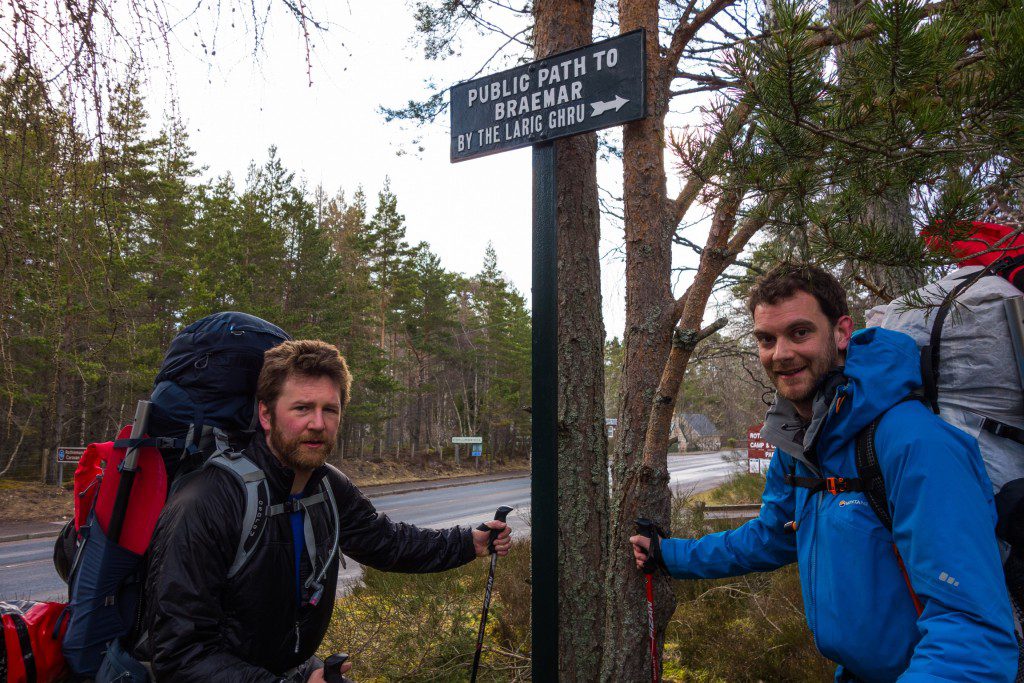
The original plan for the day had been to head round to the east out of the Lairig Ghru, towards Derry Lodge but we’d learnt that the bridge there had been washed away and fording rivers at the start of the trip had been a real hassle. So instead we decided to follow the pass down towards White Bridge and then across to the Linn of Dee. The walk would be less interesting and challenging but definitely doable, unlike the original plan. Hopefully after the Linn somewhere the river would be high enough for us to get the boats out and float down towards Braemar.

It was a pretty overcast and wet day but we appreciated that with the ridiculous sunburn we all had. We were also looking forward to walking on more solid ground again, I know Quiller had done all the falling over in snow he needed to.

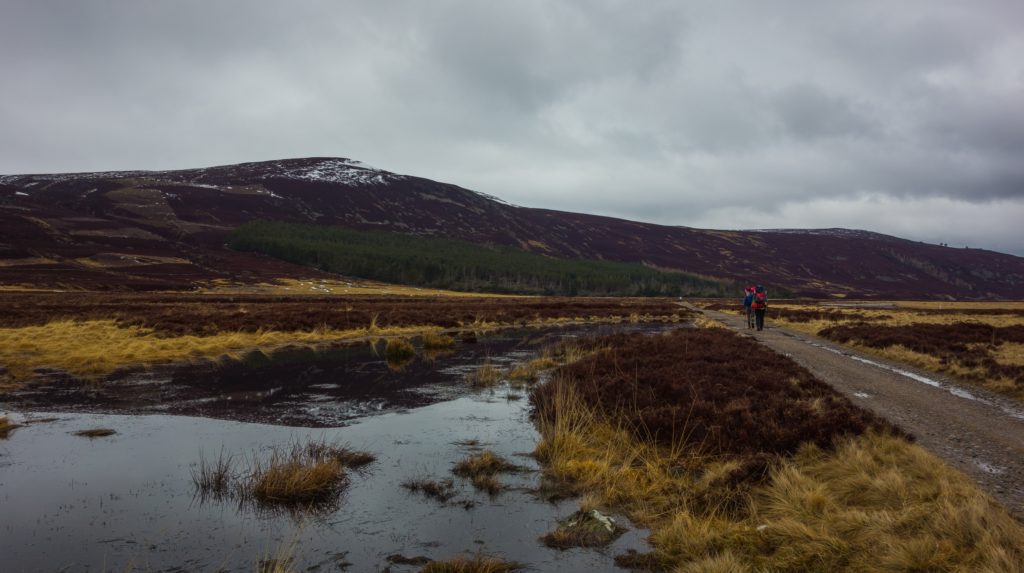
It was a pretty uneventful walk down to White Bridge and then an easy walk along the forestry trail to the Linn of Dee.  Felt good though to be walking on more solid ground as we kept watching the river for when we could put the boats in.

Good surface and mostly downhill. Waiting for the river to get bigger

Getting down to the Linn of Dee and an actual road again felt quite an achievement and we said goodbye to our bothy companion who was planning to walk along the road to Braemar and get the bus. I’m glad he had our path to follow coming through the pass and we all got through safely.

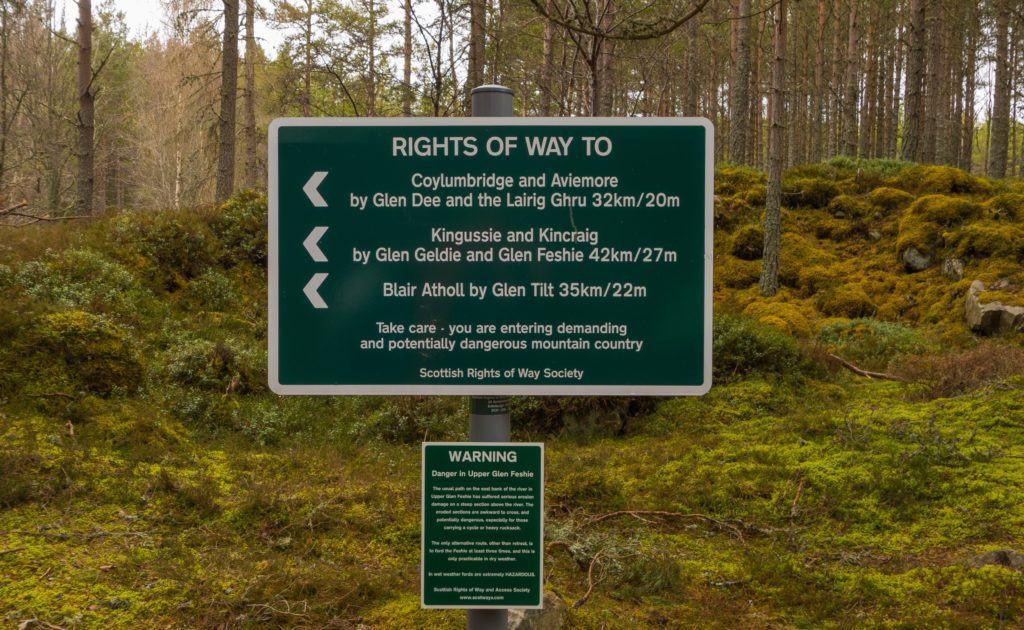
Demanding and potentially dangerous mountain country

The Linn of Dee is definitely a portage, trying to get through there would be suicidal, but not far downstream we decided to get in the boats. The river was probably high enough and we were definitely tired enough of carrying the packs. This transition seemed to take ages as Rob and I managed to do everything in the wrong order and just faff around.

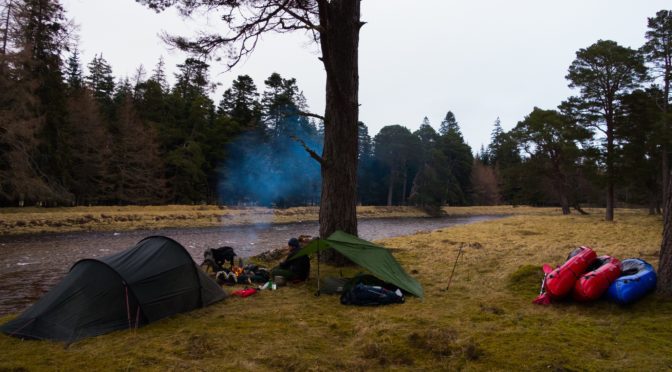
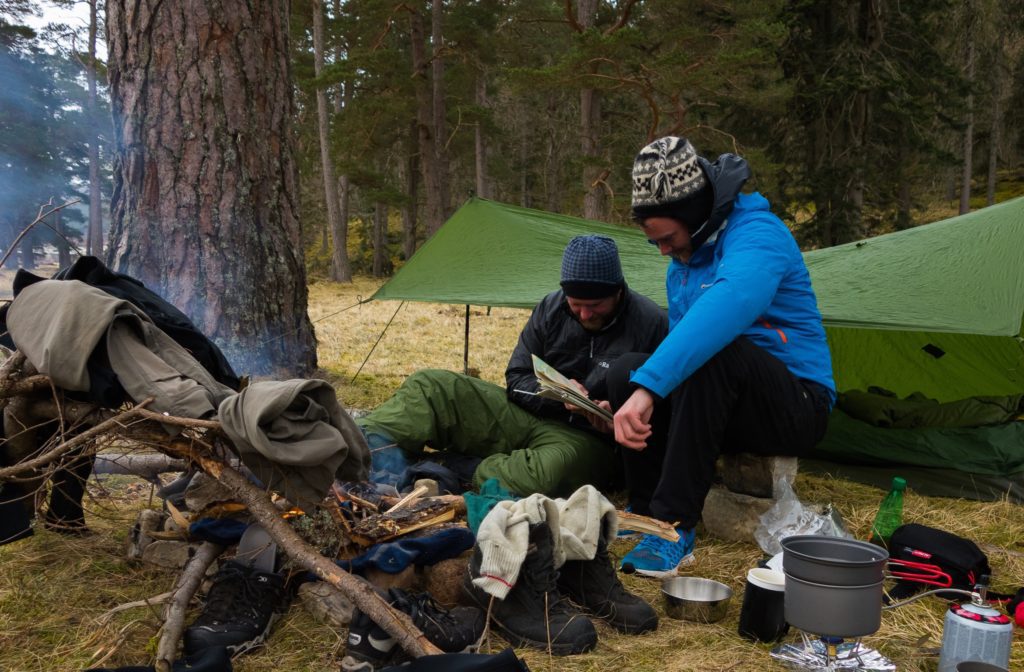
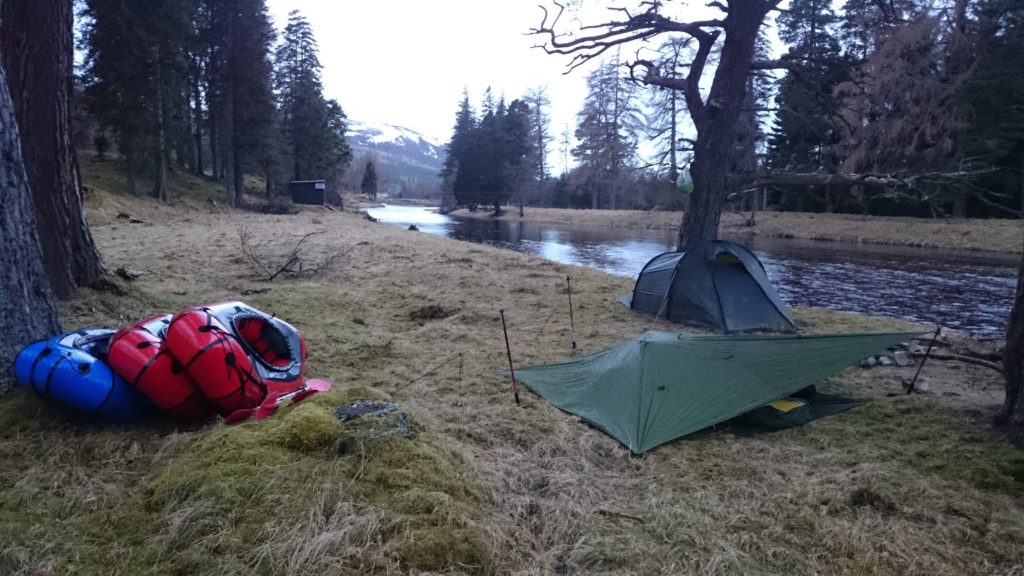
The river probably wasn’t technically high enough but the packrafts proved again their durability and also their manoeuvrability as we picked a path downstream between the rocks. We found a suitable place to stop and camp near Victoria Bridge outside Inverey. It was obvious from the many fire-blackened stone circles that lots of people had taken advantage of Scotland’s enlightened wild camping laws and stayed there by the river. There were some fallen trees for firewood (to use in an existing fire mark, not sure if we would have made a new one), it was flat, there was water from the river – a perfect spot. What wasn’t perfect was that we were pretty much out of whisky by this point.

Slightly more effective at drying

This would be the last night spent out on the trip though and it was good to finally put up the tents and tarps that we’d carried all this way. A party of three is a bit awkward with a two man tent so I stretched out under the tarp. Looking back at this now, my tarp pitching skills have definitely improved, don’t know why I’ve given myself no headroom there, even though it was quite windy.

Fantastic spot for a camp

We’d walked through from Aviemore and seen the river grow from a tiny trickle at the top of the Lairig Ghru to the power of the Linn of Dee and next day we would raft it as far as we could go. Our whisky passports we’d got at Dalwhinnie had Lochnagar as one of the stops which seemed eminently achievable the next day. No walking – just packrafting.

Bikepacking Day 1 – Hampshire & Berkshire

I had a couple of weeks to kill before starting a new job and didn’t want to spend all that time mooching around the house. I also didn’t want to have to spend a huge amount of time planning a trip abroad, booking flights, organising who to go with and so I decided to spend some time on the bike. The idea of just packing up my bike and heading out the front door really appealed to me, and when a friend suggested trying to reach the highest point in all the nearby counties then the plan was set.

In reality of course, this did involve quite a bit of preparation including buying a new bike so it wasn’t really that simple, but still I’ve got a new bike in the shed which is always good.

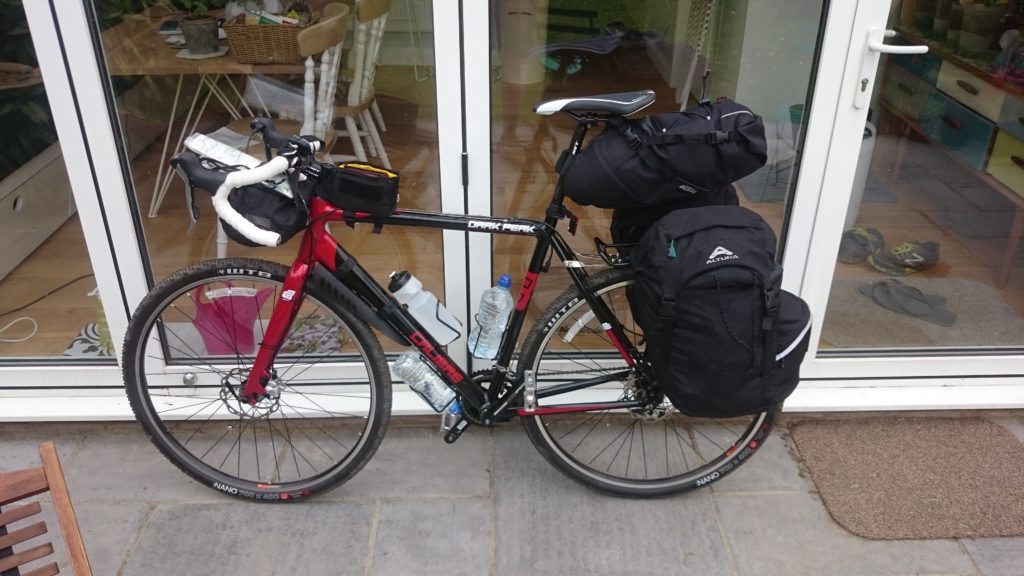
The aim was to travel as light as possible. When I’d cycled to Aberdeen a few years previously I’d just taken the one Brompton pannier, but on that trip we stayed in B&Bs and carried no food. On this trip I was hoping to camp a decent amount which meant carrying a lot more kit and food.

Bike loaded and ready to go

The first destination was Pilot Hill and Walbury Hill, the highest points in Hampshire and Berkshire and conveniently about 4km apart on the same ridge. The route from home was going to involve a bit of navigation, getting round Basingstoke and through the back roads before the final stretch on the bridleway along the ridgeline. The bridleway was the only part I was really worried about, would the heavily laden bike be able to cope with the rougher ground?


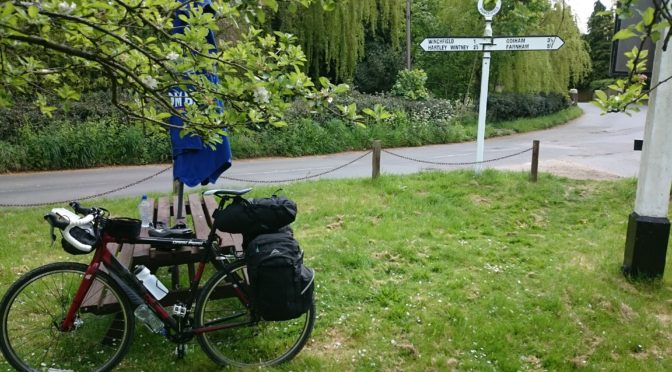
Getting up to Aldershot and on to the Basingstoke canal was easy enough, and I had a pleasant ride through to Basingstoke. Getting round the outskirts of Basingstoke was a little more tricky but finally I passed the town and was onto the back roads looking for the turning for the wayfarers walk. I’d scouted this on Google street view before leaving and the turning was where it should have been. Turning up the bridleway was the moment of truth: if I could stay on the bridleway then it was a fairly straight shot up to Pilot and Walbury Hill; if not then it would be a lot of back and forward on the back roads. The bike had coped well on the canal towpath apart from the panniers jumping off every now and then on the big bumps, and it coped well on the stony bridleway. It was great to get off the roads and very quickly feel that exciting isolation.

Just me and a buzzard

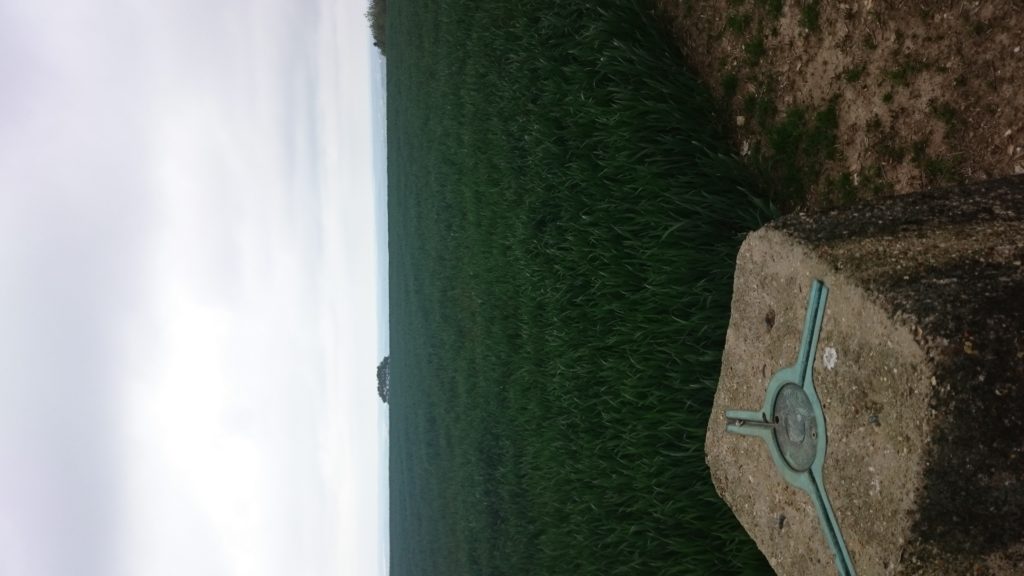
I got up to Pilot Hill and after asking a passing dog walker I found the trig point in the middle of a field.

The highest thing in Hampshire

By now it was about 6pm and I was getting pretty tired and in need of somewhere to pitch a tarp. The ridge was quite a bit more busy than I was expecting with lots of dog walkers and runners out. I pushed on to Walbury Hill and then continued on to find a place to camp. There was a strong wind coming over the ridge from the south so a bit of shelter would be nice. The trouble with camping on hills is that they are generally pretty exposed, and not always flat. I’d tried camping on the side of Ditchling Beacon before and had woken up tangled up in a fence having slid a fair way from where I went to sleep. It didn’t make for a good night sleep.

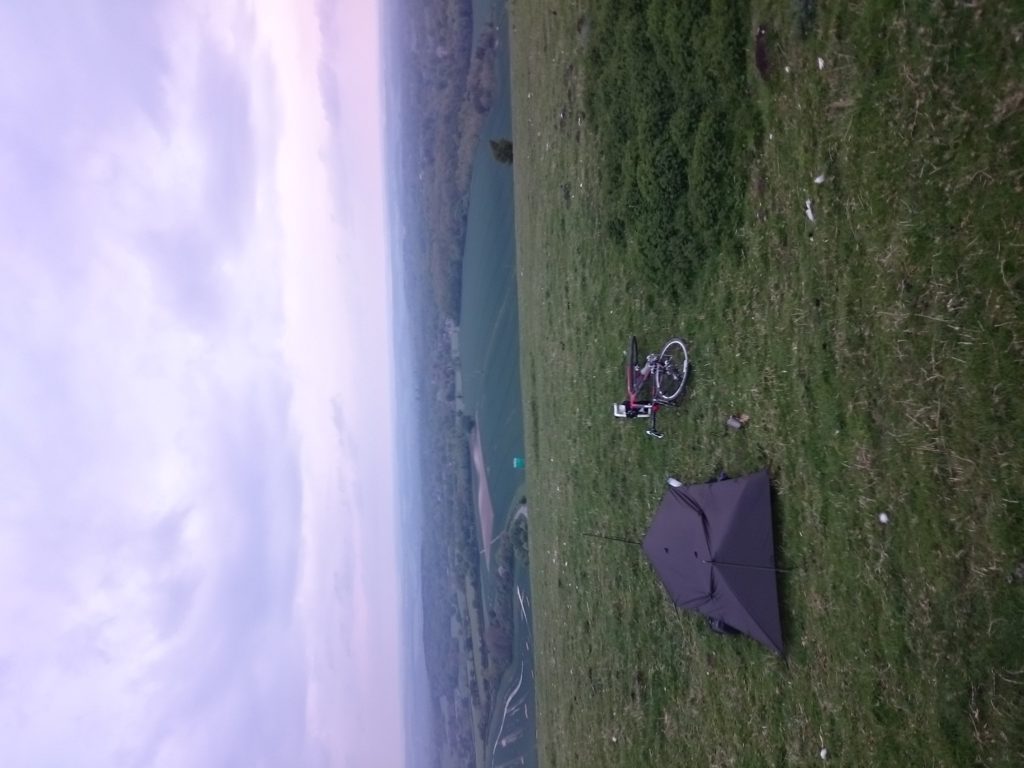
Trees are generally good places to camp, they block the wind and rain and you can be very inconspicuous in them. But they tend to grow on the sloped parts of the hills and I hadn’t packed a hammock. I carried on from Walbury Hill and spotted a flat piece of ground sheltered by a little ridge that looked like it would be perfect. There was a car parked right near it and I would be in sight of the carpark so I decided to stop there for a little while and see if it quietened down enough for me to feel comfortable getting the tarp up. There was a car parked right up near the gate with a middle-aged couple in it doing nothing, they didn’t move so I decided that I’d probably move on. However as I went past them they spoke to me and it became clear that they wouldn’t be trying to move me on if I did camp there. I’ve got no idea what they were doing up on the hill but I was carrying a knife and could always turn down any dogging advances and I was too tired to try and find somewhere else. So I went back into the field and got the tarp up.

No headroom but a great view

I cooked up some dinner using my supercat stove which worked great. I had slightly misjudged my water requirements though and there aren’t any rivers on the top of hills, this made for a thirsty evening. I slept ok although I could have done with tightening up the lines a bit more. Paracord will sag when damp and this made the tarp more flappy and noisy than would have been ideal. Some sheep passed in front of me and some people came to inspect the gibbet near midnight which was creepy but I was very snug and cosy in my bag and went to sleep pretty pleased with how day one had gone. The forecast for day 2 wasn’t great and I had a fair distance to cover to get to Glastonbury but I had a B&B waiting for me at the end of the day. Plans of reading the kindle or writing anything were abandoned in favour of getting my head down.

Packsledging 4 – Aviemore to Braemar part 1

The old bunk house was as comfortable as we remembered and we had a great meal at the pub next door. We were a day ahead of schedule here so decided to spend the next day looking into whether we would be crossing the Lairig Ghru or whether we were going to need another plan.

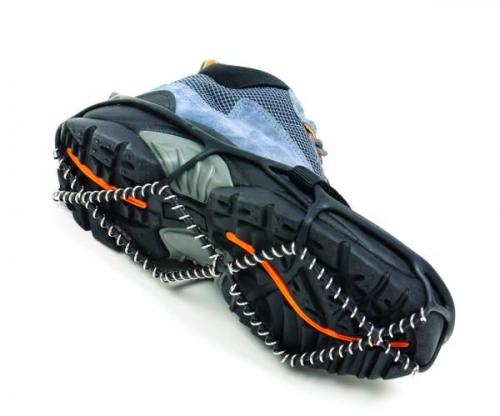
After breakfast the tourist information office was our first stop and they were less than encouraging, suggesting that we would be mad to try and get through the hills. This wasn’t the answer we were looking for so we needed someone else to ask. We wandered round outdoor shops as I looked for some more serious upgrades over the Yaktrax I had taken for icy walking

"Perfect for dog walkers" - maybe not for winter in the Cairngorms
“Perfect for dog walkers” – maybe not for winter in the Cairngorms

To be fair I had used them in the Brecon Beacons and they made a big difference, but Rob and Quiller were carrying much more aggressive looking crampons and I didn’t want to be the one who stopped the group getting through. Ultimately I didn’t get anything, mainly because I couldn’t face the extra 700g of crampons to carry.

So the Tourist Information guys told us not to go, staff in the various outdoor shops had been pretty noncommittal so I decided to go straight to the top and managed to get the head ranger for the Cairngorm area on the phone. Just as we were thinking about what our other options were, he came through that we should be fine so long as we have winter boots and gaiters and don’t mind breaking a trail. Also it was forecast to be very sunny so we should take sunscreen with us. This was the best possible news, we were on for the Lairig Ghru. It’s possible that we should have paid more attention to the second part of his advice though, rather than getting so excited about getting the go message.

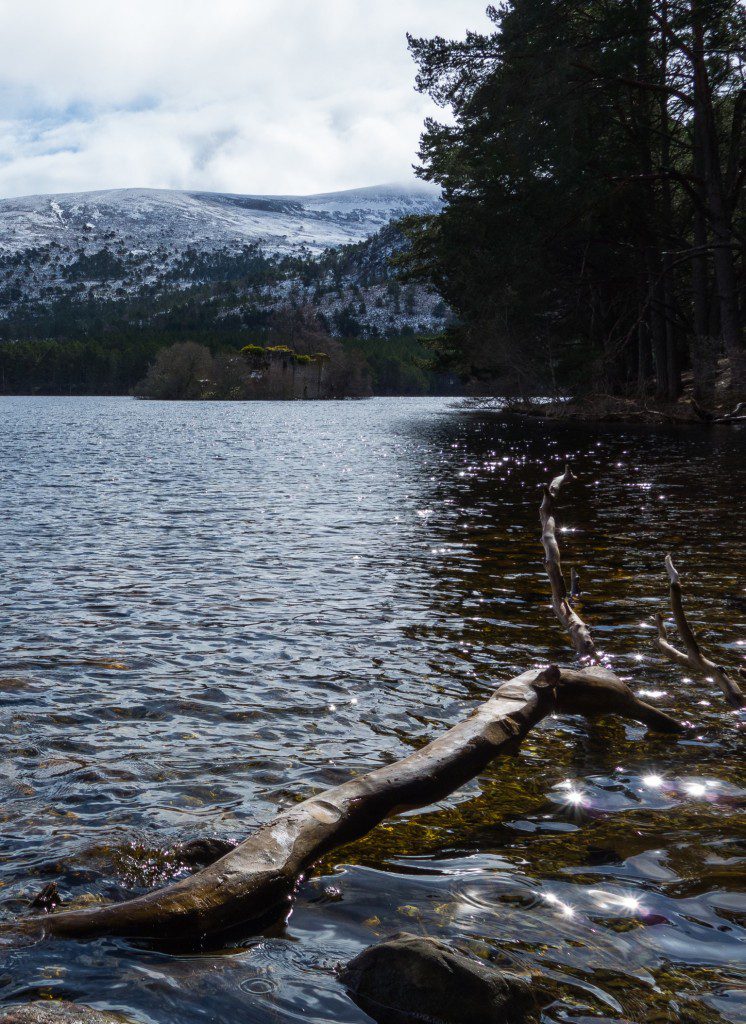
We put together a picnic and headed out to visit Loch an Eilein. It was great walking with light packs and the weather was good. Loch an Eilein has a small castle in the middle of it, normally inaccessible unless you want to swim or you have a boat. Well of course we had boats so this was perfect.

I wish I had some way to get out and visit that ruined castle...
I wish I had some way to get out and visit that ruined castle…

After having a look round the castle we walked over to cross onto the River Spey and floated back up to the bunkhouse.

Rob showing an alternative portage technique, the rafts are so robust

This was some of the most pleasant rafting of the trip, the weather was good, the water just kept taking us where we needed to go and the countryside was great. An ideal packrafting day trip.

Floating down the river

That evening we gorged on pizzas, I went to pick up some firelighters that we’d forgotten and we then headed back over to the pub to listen to Dan Korn and his band, who were excellent. A very early start was planned and we were all nervous again like on the train, but excited.

I think we left the hostel around 5.30 or 6 in the morning after a massive calorie loaded breakfast. Then it was time to get moving, although the packs seemed to have got heavier again.

We hadn't even started going uphill yet but I was feeling it
We hadn’t even started going uphill yet but I was feeling it

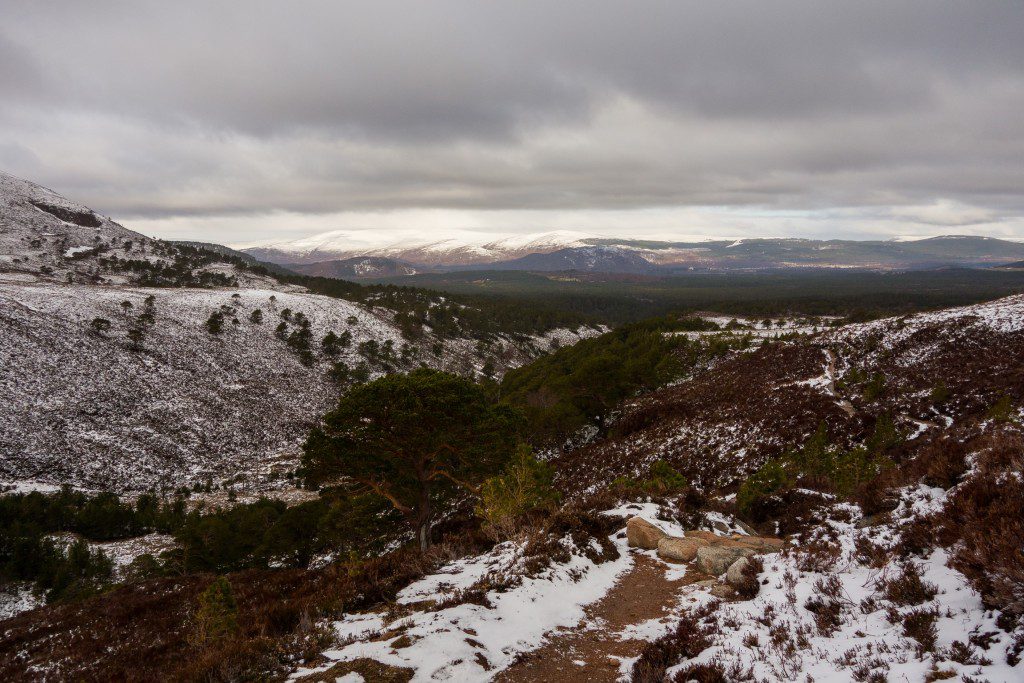
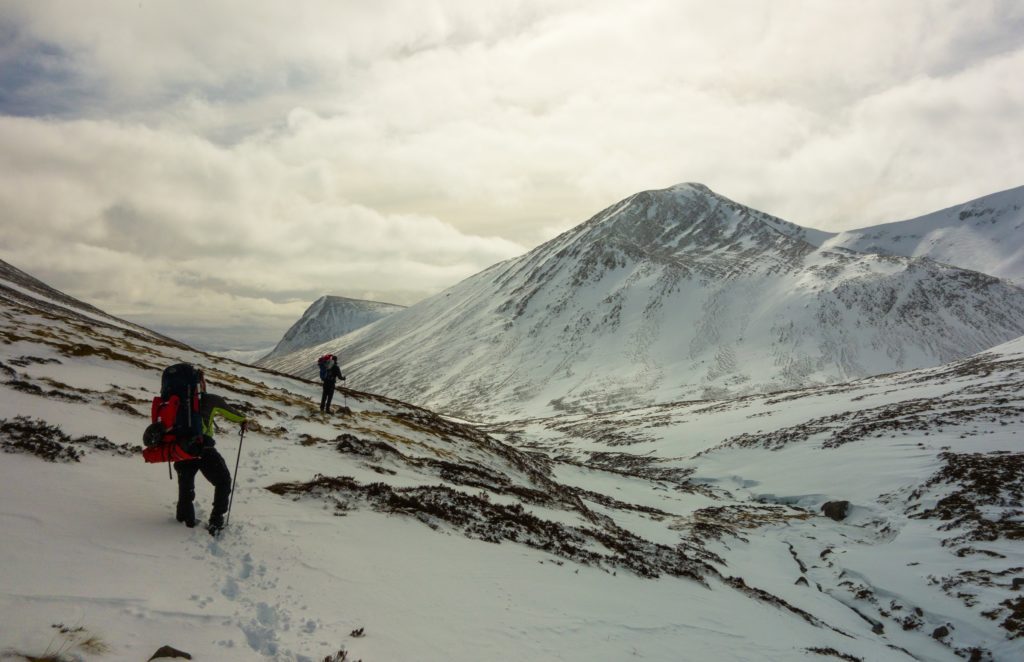
The first bit of the route, walking alongside the road, was the worst and then going through the forest was great, very quiet and peaceful. Slowly though we were climbing out of the trees and into the snow…

Out of the forest, but that was a tough climb

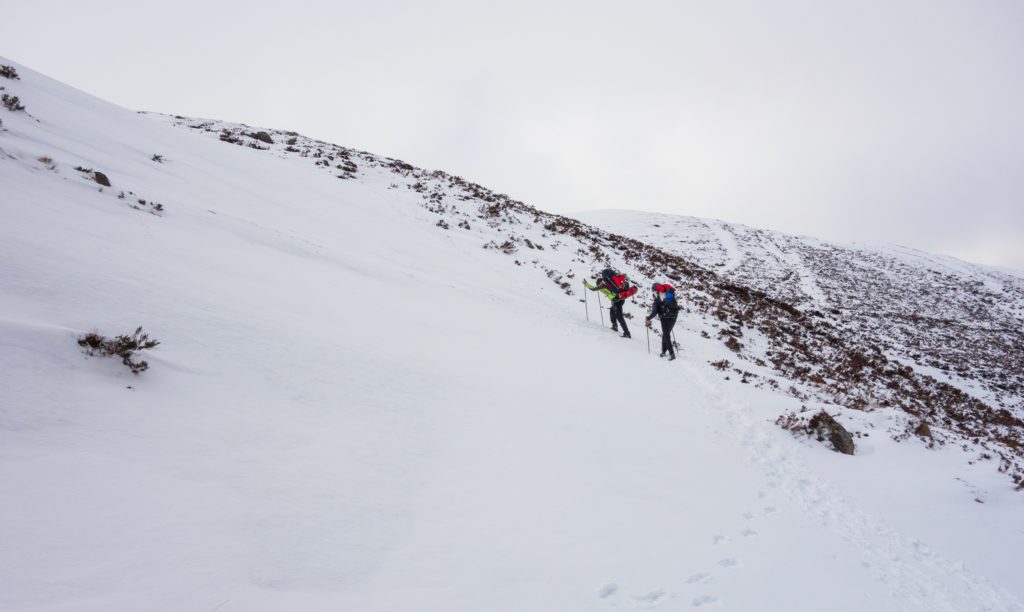
The lemon sherbets were really coming into their own by this point, but the snow was getting thicker and I was certainly glad that we’d got going so early. The walking was pretty straightforward until we got to a point where we couldn’t actually tell where the path went. On the map the path was next to a stream and it was impossible to tell just how deep the snow was and what was at the bottom of it. Nothing was particularly difficult, but it would have been a big issue to get someone out who had been injured so we were being cautious. The packs didn’t help with agility either but my yaktrax were surprisingly non-useless

Definitely no river under this bit of snow

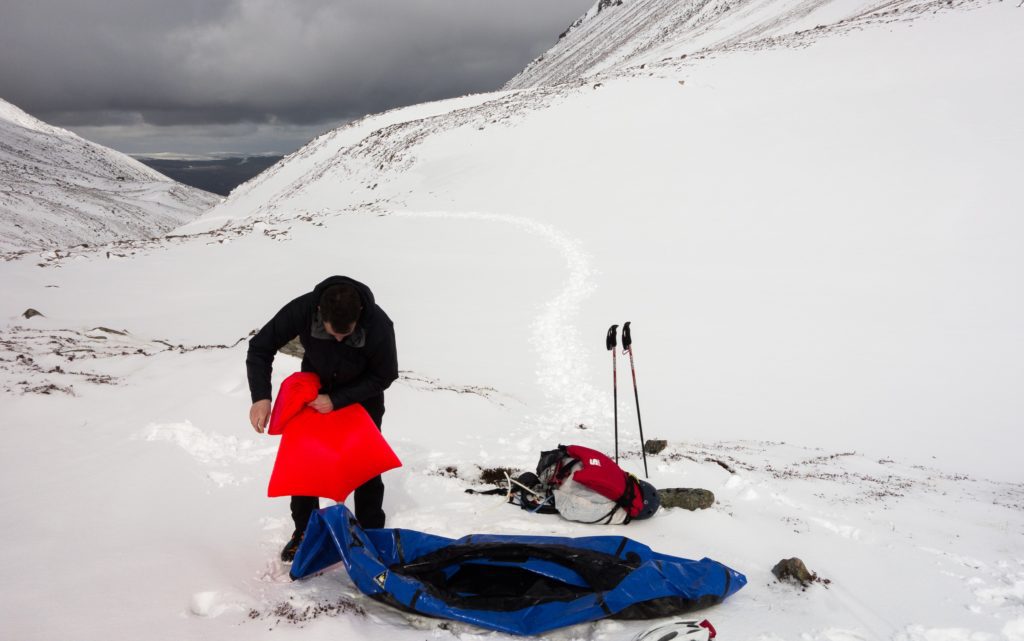
At about lunchtime we got to the highest point of the pass and a great snow-covered bowl area which was perfect for sledging. We weren’t carrying sledges, but snow is basically water so the boats should work shouldn’t they? Quiller inflated his and invented the new sport of pack-sledging while Rob and I got lunch together. This earned us some very funny looks from a group of runners who came through, although running through that snow seemed like a pretty stupid idea as well to me…

Packsledging!
Packsledging!

During the afternoon the sun came out and we remembered the other piece of advice the head ranger had given us and laughed about how much we had ignored it. This period of walking was quite tiring, just because finding the path was very difficult and with every step you weren’t sure how deep you were going. We took turns at the front and Quiller did his best to keep morale up by falling over in increasingly comedic ways.

getting there
getting there

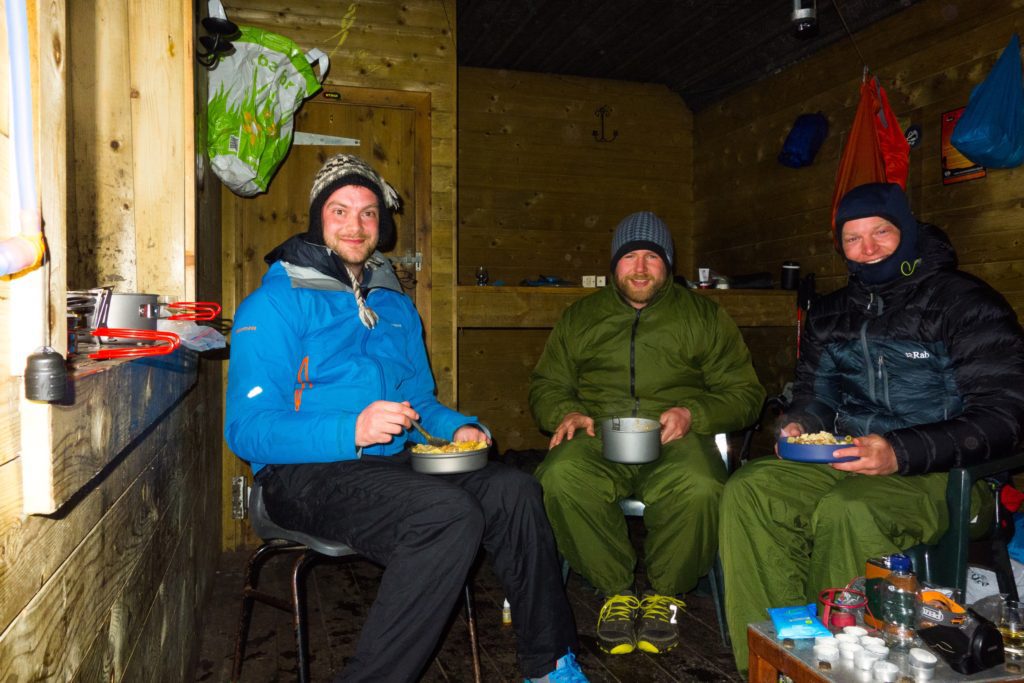
We finally made it to the bothy at about 4.30, all pretty well sunburnt, tired, but excited and glad to have made it. Quiller cooked up a fantastic meal of cheesy mushroom pasta and we drank whisky and enjoyed the view and the quiet.

Quite sunburnt
Quite sunburnt

On of the things about staying in a bothy is you’re never sure if you’re going to be there alone, or who else you’ll be sharing the place with. At about 1800 we spotted another walker coming in after us, making for the bothy. I didn’t manage to catch his name but he was doing again a walk he’d done 20 years previously. I think he’d been a bit surprised by how difficult it was and I certainly didn’t envy his dinner of a tesco chicken sandwich. You don’t want to appear patronising in those situations but I was glad that we’d broken a path for him to follow and he’d got into the bothy ok.

The plan for the next day was to walk down to the Dee, past the Linn of Dee and see where we could get the rafts in before floating down the river and finding a spot to camp, but we could be happy with what we’d achieved so far.

Getting into Whisky for Burns Night

At Burns Night you have to drink whisky. Well, you don’t have to, but you don’t have to do anything really. I strongly recommend drinking whisky though, on Burns Night and on most other nights. But whisky is not a particularly accessible drink, and if you get your first few whisky experiences wrong then you’ll end up with a lifelong aversion to this magnificent spirit.  Also there has been an explosion of interest in whisky in the last 5 years or so, meaning that supermarkets are carrying a much wider range and distilleries are producing a lot more varieties. Prices have also gone up, making buying whisky a bit more daunting for the beginner. So here is a quick guide for buying and drinking whisky for Burns Night, or any other night, or during the day because conventions and customs are just products of our imagination.

When drinking whisky, add water. Add as much water as you need so that it doesn’t burn your mouth and you can taste it properly. Don’t use ice or really cold water, cold things have less taste (hence why you keep vodka in the fridge and lager is best served cold) and you want to taste the whisky. You want it strong enough to be warming, but not burning. Don’t feel bad about doing this, unless you have bought a bottle at cask strength (c. 55% alcohol) then it’s already been watered down before being bottled. So add some water and get it to a level where you actually taste the stuff. Maybe in the future you’ll become accustomed to the burn and enjoy it, but for now add the water.

For your first whisky, get a good blend like Chivas Regal, Monkey Shoulder or Ballantines. Blends are designed to be smooth, with no one flavour predominating so are an excellent starting point into whisky. Don’t buy a litre bottle of Bells unless you’re very clear about what sort of night and following day you’re after.

Single malts are not necessarily better than blends but they are generally more expensive because at least half of a blended whisky will be grain whisky which is cheaper to produce and has a more neutral flavour. If you want to go for a single malt, then stay safe and get one of the glens like Glenlivet, Glenfiddich or Glenmorangie. These are all excellent whiskies from the main whisky area of Scotland around the River Spey. They are smooth, not too fruity and unpeated. Avoid anything that is finished in a wine cask or something like that, plenty of time for those later.

There are two main flavours of whisky and at some point you’re going to want to explore the wild outposts of peat. Whiskies from Islay taste like nothing else. They are made with barley that has been dried in peat smoke and taste smoky, salty and medicinal. The first time I had a Laphroaig (pronounced Laff-roy-g) I thought I’d accidentally licked an ashtray and I was still tasting it the next morning.  It’s great whisky but try someone else’s before you decide to buy a bottle. Laphroaig and Ardbeg are probably the most commonly available Islay whiskies and the standard 10 year olds are great. If you can find the Laphroaig Quarter Cask then that’s slightly less peaty having picked up more wood flavour from the smaller cask – it’s excellent and great value.

(As a side note, Ardbeg Uigeadail and Corryvreckan are two of the last good deals you can get at duty-free. For £50-£60 you will struggle to buy better whisky. The standard Ardbeg is good but these are great.)

The other big flavour is sherry, which comes in when the whisky is aged in casks that used to hold sherry. Whiskies like Aberlour and Glendronach taste of dried fruit and Christmas pudding and smell fantastic, so go in for something like that if that appeals. To check how sherried a whisky is, just look at how red the liquid is in the bottle, the more colour it has the more sherry flavour it has picked up from the whisky (unless it’s a cheap whisky that has had colour added).

But whatever you do, add some water, smell it before you taste it and hold it in your mouth for a while. You won’t be drinking a lot of whisky, or at least you won’t remember drinking a lot of whisky so savour the drinks you do remember and think about what you’re drinking.


Packrafting 3 – Dalwhinnie to Aviemore

Last time we’d just left the Dalwhinnie distillery with another bottle of whisky and also 3 small tasting glasses. I had little to no hope that we would be able to transport these glasses intact across the Cairngorms but they were too nice not to try.

Nothing like an early morning whisky tasting to prepare for a day of rafting


I should mention at this point that we were all fully convinced of the merits of an ultra-light approach to backpacking and were doing anything we could to make our packs lighter. I had stopped filling my water more than about half full since day 1 as there was water all around us. Quiller had perhaps taken things to extremes by not packing any form of mug, but Rob and I were very jealous of his extreme lightweight pack.

The plan from Dalwhinnie was to take the rafts along the river Truim until it met the Spey and then on to Newtonmore. This would be the first time taking the rafts on a moving body of water and we were fairly apprehensive about ending up going down rapids or over a waterfall or something but looking at the map and doing some research online it seemed like the only thing we had to worry about was the Falls of Truim about half way to Newtonmore.

We’d heard amazing things about how the rafts could float in 6 inches of water and looking at the map the river seemed like a fairly decent size so we decided to go for it. The clincher was that there was no other obvious route to the Spey that didn’t involve walking alongside a road. It had snowed heavily overnight and we fancied getting back in the boats.

Transitioning - we got this down to about 10 min by the end
Transitioning – we got this down to about 10 min by the end

What followed was a very frustrating and nerve-wracking hour or two as we partly floated and mostly walked down the river, dragging our rafts. Grounding out is not something you really want to do in inflatable boats but despite our best efforts to find the deeper water we couldn’t help but hit the bottom often.

This was probably the low point of the trip for me. The river meanders (as rivers do) and so we were covering tiny distances on the ground in exchange for a lot of effort. Having wet feet wasn’t a problem, David Hine’s recommended approach of woolly socks inside neoprene socks was excellent and kept everything warm. But trying to drag / carry the raft plus the large pack it had strapped to it was a challenge.

Quiller and I trying different body positions and lines in the river to get through the shallows
Quiller and I trying different body positions and lines in the river to get through the shallows. Life jackets not required

The river did get deeper though, and we were rewarded with our first short bits of fast water which were a lot of fun. I think we finally reached the Falls of Truim around 4.30 which was pretty good considering how slowly we covered the first few km. The Falls was definitely a portage for us considering the gear we were carrying and our lack of rafting experience but by then we were pretty cold and wet and tired and welcomed the chance to transition again and complete the journey on foot.

Transition complete. River is wider here but still pretty shallow

So we took on another route march for a couple of hours to get into Newtonmore. It was all along a cycle path next to a main road which wasn’t particularly interesting but did mean that we could put down a pretty solid pace and we were soon at the hostel in Newtonmore.

This is more what we were looking for: the Spey

The hostel was great, the drying room was very welcome as was the hotel bar across the road where we feasted and I started drinking strawberry beer for some reason (it was on offer), before we headed back over to sit round the fire, drink whisky and impress Austrian tourists with how manly we were (very).

The next morning the plan was to get down to the Spey and take it all the way to Aviemore, maybe stopping for lunch at Loch Insh on the way. In the original plan we had thought about taking a taxi from Dalwhinnie up to Kingussie or Loch Insh, but we were a day ahead of schedule and decided to keep going under human power.

We were finally on the Spey and it was a much better river for rafting than the Truim, the first hour or so was really enjoyable as we could sit and float downstream. It’s great to be able to just take a a break but keep moving towards the goal.

Great not to have worry about hitting the bottom

Rob had somehow managed to put a small hole in the top of his raft when packing it up one day so we had a small stop to repair it but repair it we did. Not easy to do in the snow but a combination of toilet paper and ethanol managed to dry the raft enough for the patch to stick.

As the day continued though the weather got steadily worse as the wind picked up and the snow showers became more and more intense. Due to the large tubes riding high of the water the rafts are not good in wind – great when it’s with you, but unless the river is a dead straight line (like Loch Ericht) then it can get pretty tricky. We persevered for a while until none of us was having any fun and we were finding it difficult to make progress. So it was time to transition and get walking again.

Scottish weather is ridiculous

This was tough, the ground was soft and boggy and the weather alternated between snow and strong wind and bright sunshine. Scotland really is generous with giving you all of its weather. It was frustrating to have to follow the meanders of the river, but there was no way we could have cut across the softer lower ground. The last bit did involve finding a path through a pretty deep bog but we got through and eventually made it to Loch Insh around 3pm. We had a massive amount of food and a few beers in the sailing club cafe and as we watched the wind coming across the loch we decided that we could probably just get a taxi the last stretch to Aviemore.

It was a shame to not be able to cover the whole distance under our own power, but none of us really fancied trying to raft in that wind or walking alongside a road for 2 hours. Especially after burgers, macaroni cheese and pudding. It is amazing how fast a car is when you have been walking and rafting.

We checked in to the Old Bunk House in Aviemore and started to work out what we were going to do the next day. The weather for crossing the Cairngorms was looking dangerous so we needed to get some more information and potentially come up with a back up plan.