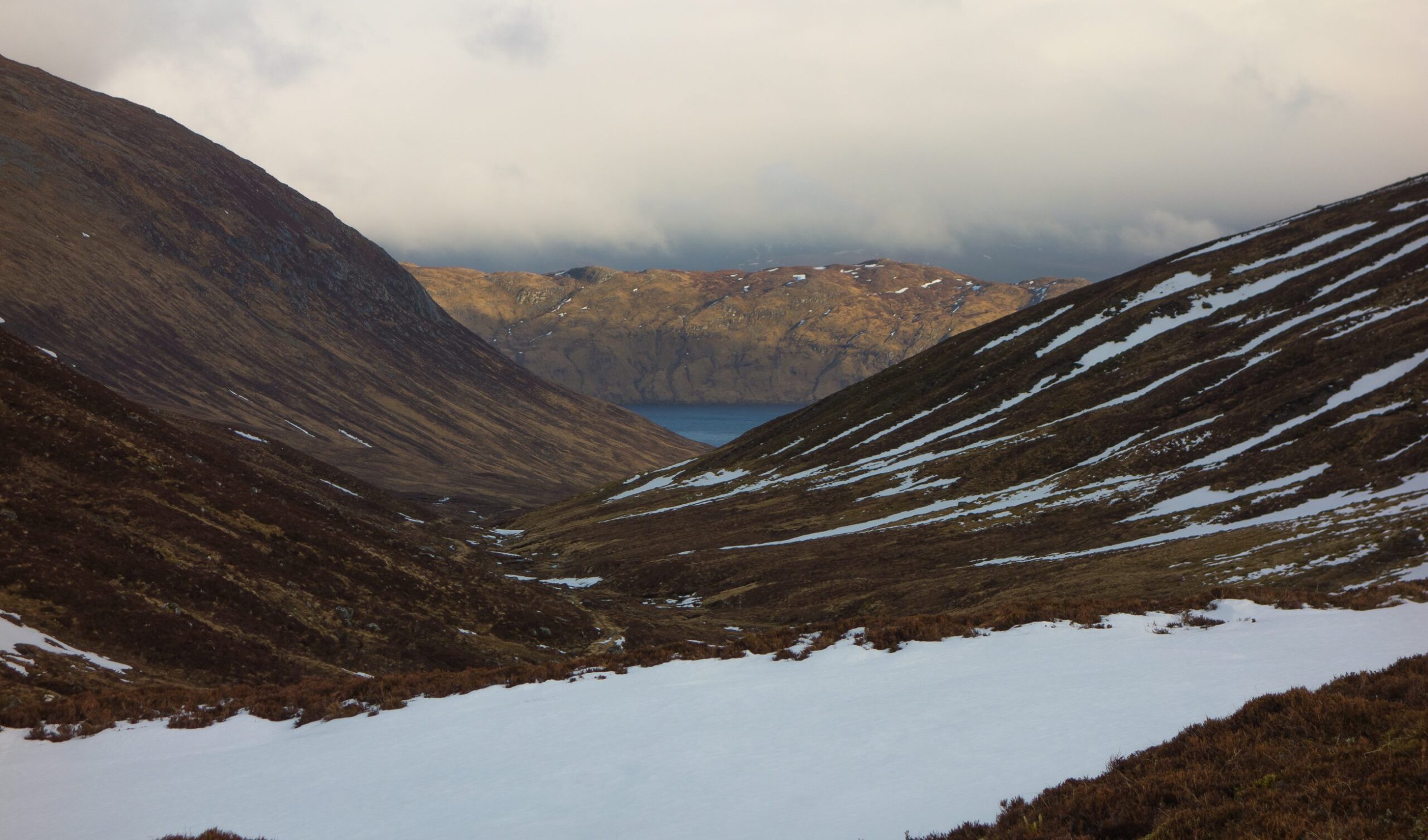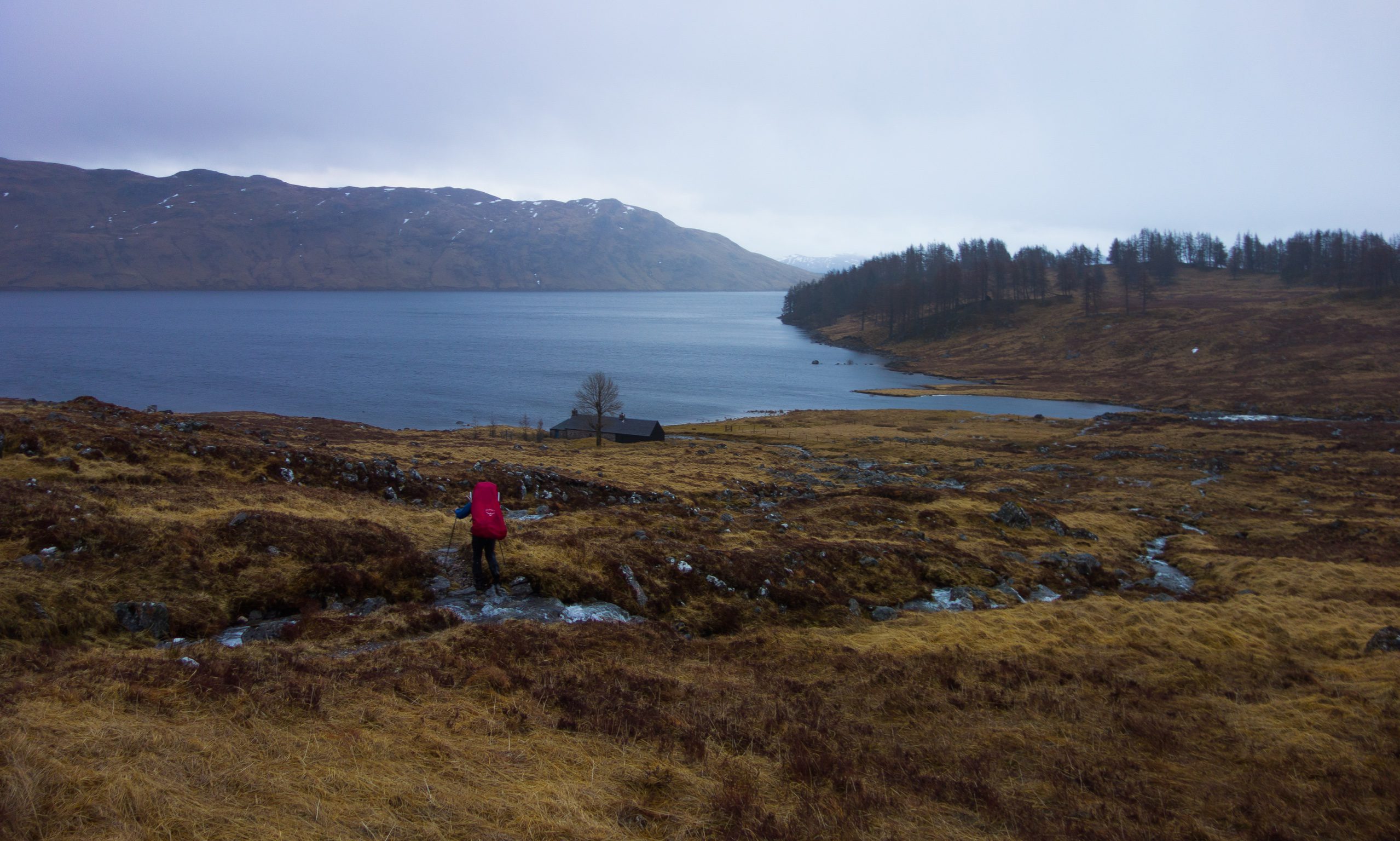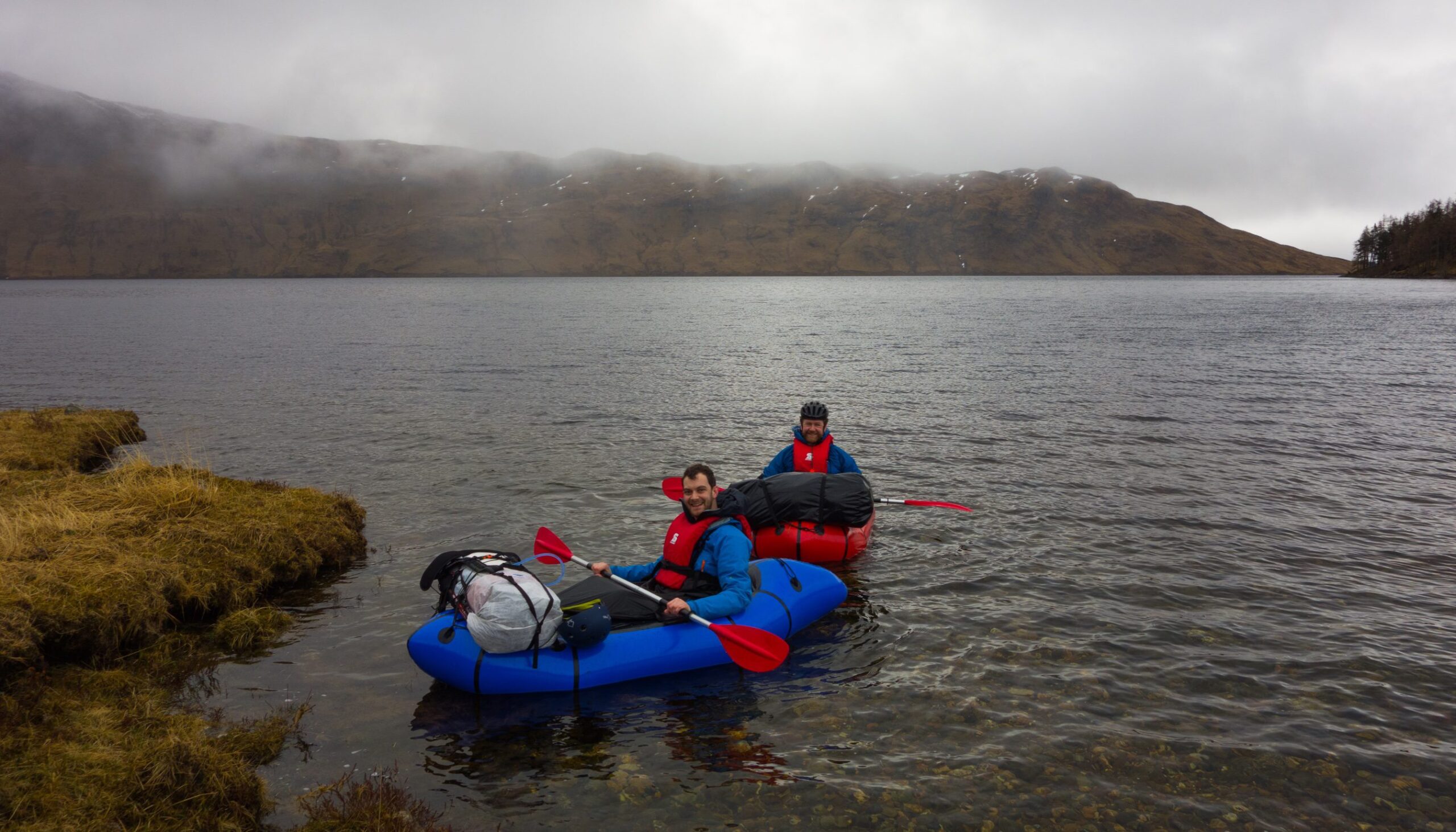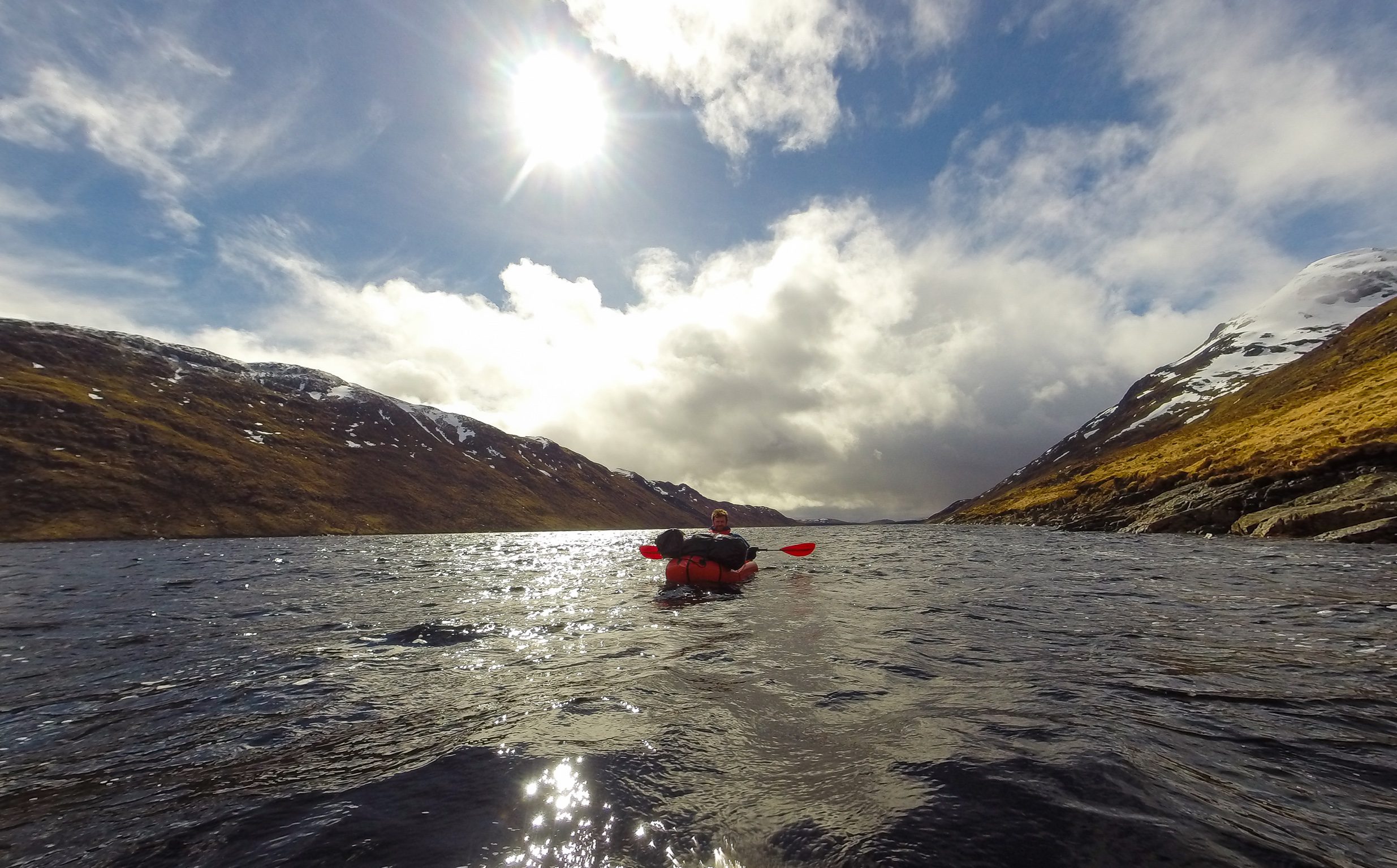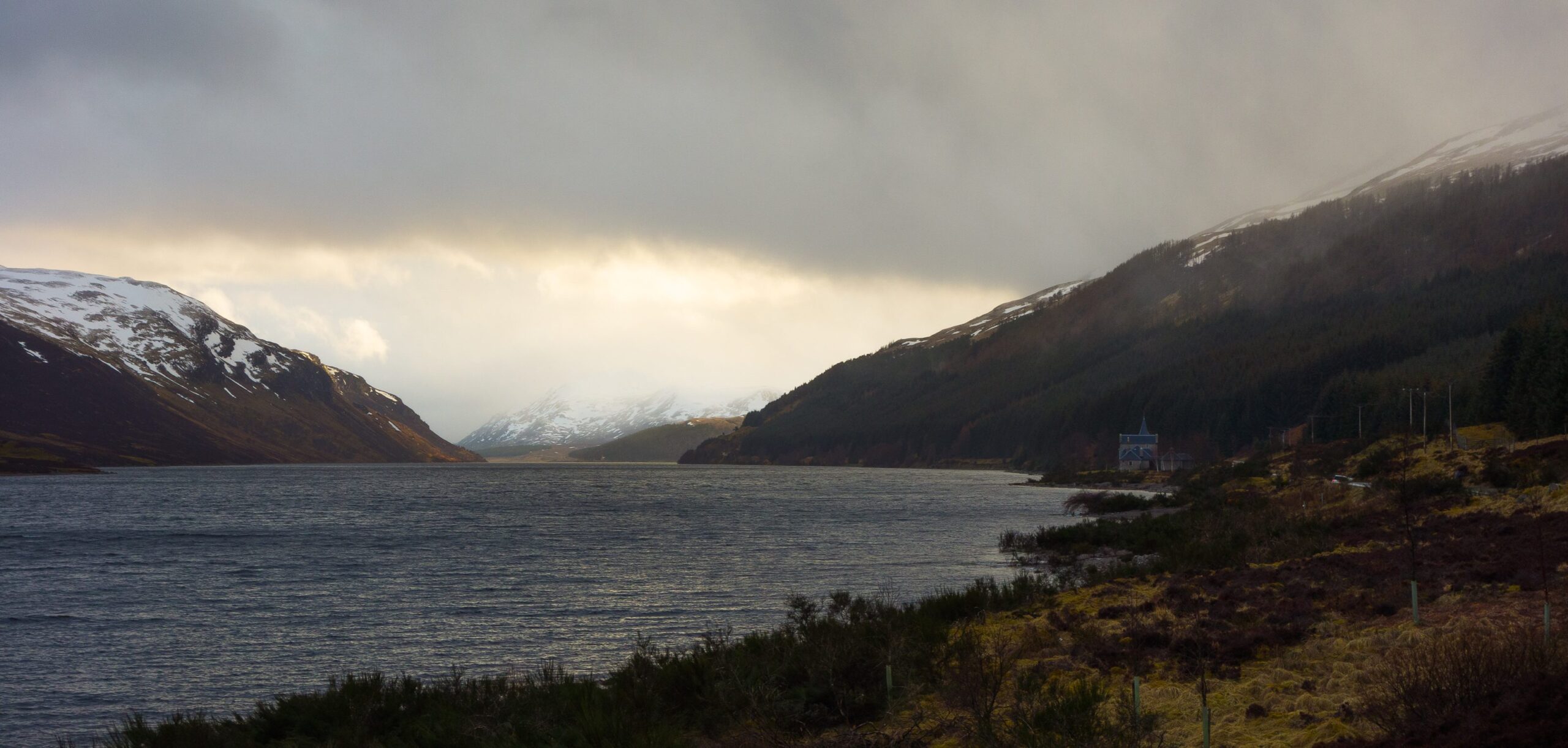
Packrafting 3 – Dalwhinnie to Aviemore

Last time we’d just left the Dalwhinnie distillery with another bottle of whisky and also 3 small tasting glasses. I had little to no hope that we would be able to transport these glasses intact across the Cairngorms but they were too nice not to try.
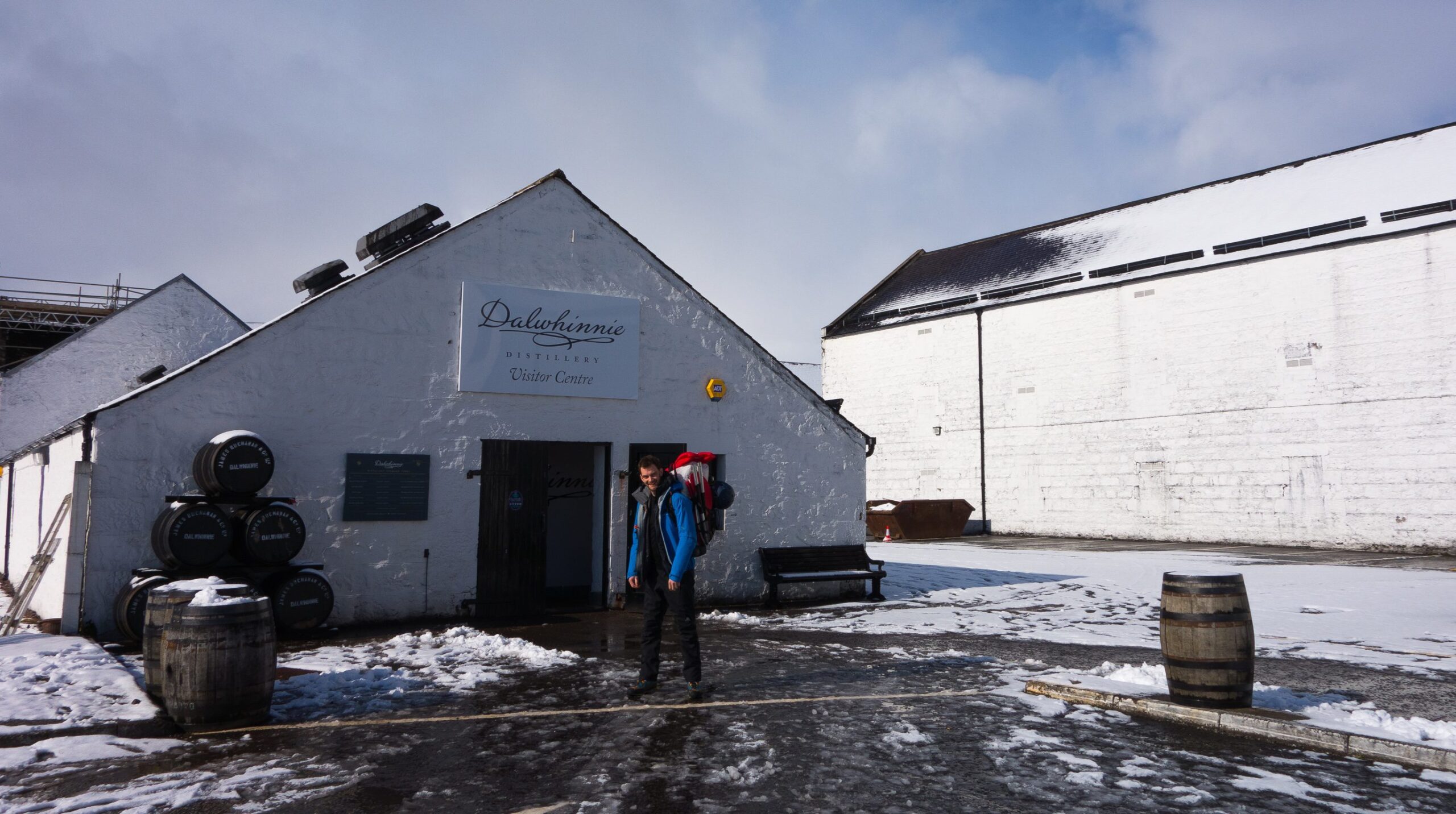
Nothing like an early morning whisky tasting to prepare for a day of rafting


I should mention at this point that we were all fully convinced of the merits of an ultra-light approach to backpacking and were doing anything we could to make our packs lighter. I had stopped filling my water more than about half full since day 1 as there was water all around us. Quiller had perhaps taken things to extremes by not packing any form of mug, but Rob and I were very jealous of his extreme lightweight pack.

The plan from Dalwhinnie was to take the rafts along the river Truim until it met the Spey and then on to Newtonmore. This would be the first time taking the rafts on a moving body of water and we were fairly apprehensive about ending up going down rapids or over a waterfall or something but looking at the map and doing some research online it seemed like the only thing we had to worry about was the Falls of Truim about half way to Newtonmore.

We’d heard amazing things about how the rafts could float in 6 inches of water and looking at the map the river seemed like a fairly decent size so we decided to go for it. The clincher was that there was no other obvious route to the Spey that didn’t involve walking alongside a road. It had snowed heavily overnight and we fancied getting back in the boats.
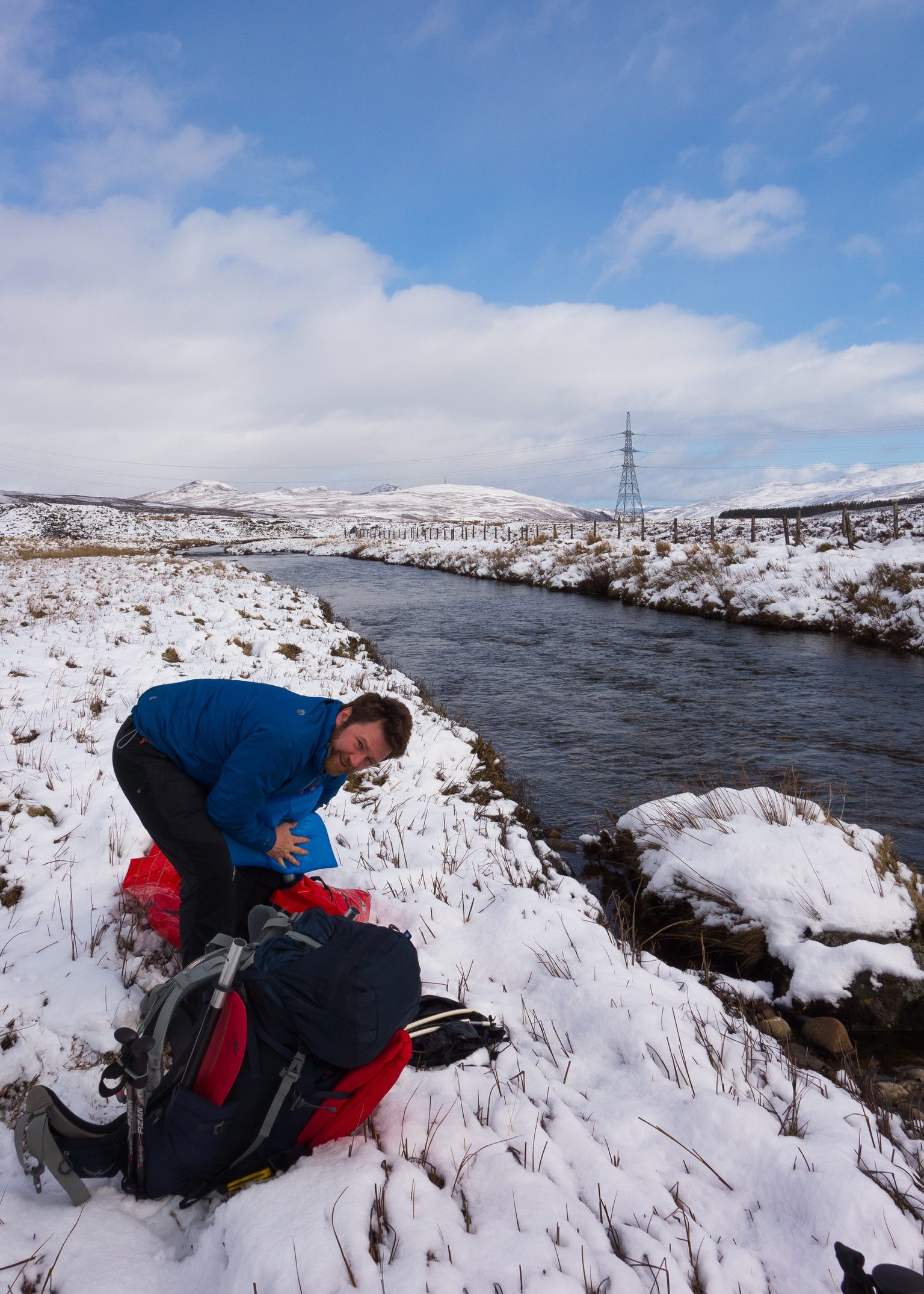
Transitioning - we got this down to about 10 min by the end
Transitioning – we got this down to about 10 min by the end

What followed was a very frustrating and nerve-wracking hour or two as we partly floated and mostly walked down the river, dragging our rafts. Grounding out is not something you really want to do in inflatable boats but despite our best efforts to find the deeper water we couldn’t help but hit the bottom often.

This was probably the low point of the trip for me. The river meanders (as rivers do) and so we were covering tiny distances on the ground in exchange for a lot of effort. Having wet feet wasn’t a problem, David Hine’s recommended approach of woolly socks inside neoprene socks was excellent and kept everything warm. But trying to drag / carry the raft plus the large pack it had strapped to it was a challenge.
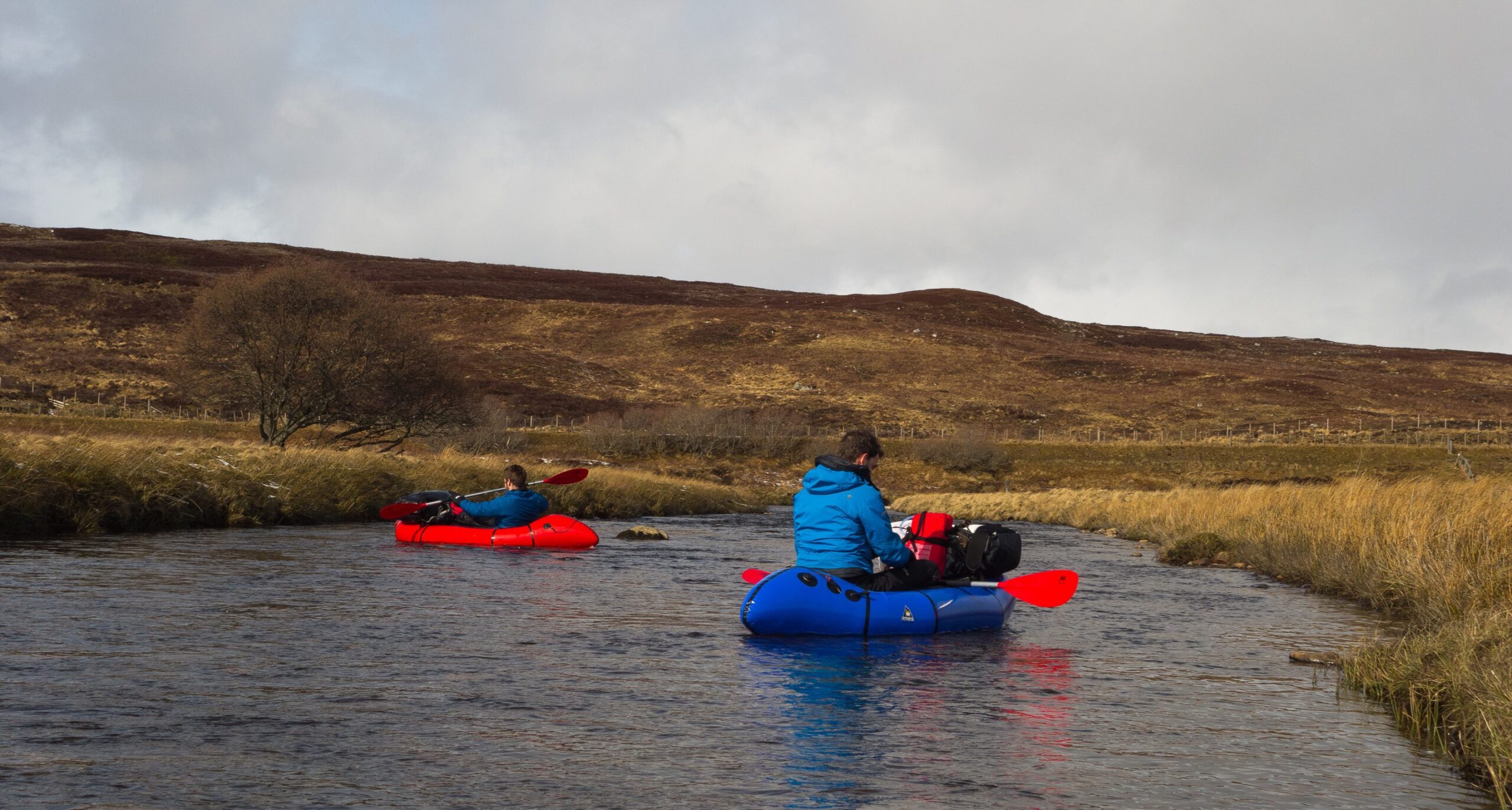
Quiller and I trying different body positions and lines in the river to get through the shallows
Quiller and I trying different body positions and lines in the river to get through the shallows. Life jackets not required

The river did get deeper though, and we were rewarded with our first short bits of fast water which were a lot of fun. I think we finally reached the Falls of Truim around 4.30 which was pretty good considering how slowly we covered the first few km. The Falls was definitely a portage for us considering the gear we were carrying and our lack of rafting experience but by then we were pretty cold and wet and tired and welcomed the chance to transition again and complete the journey on foot.
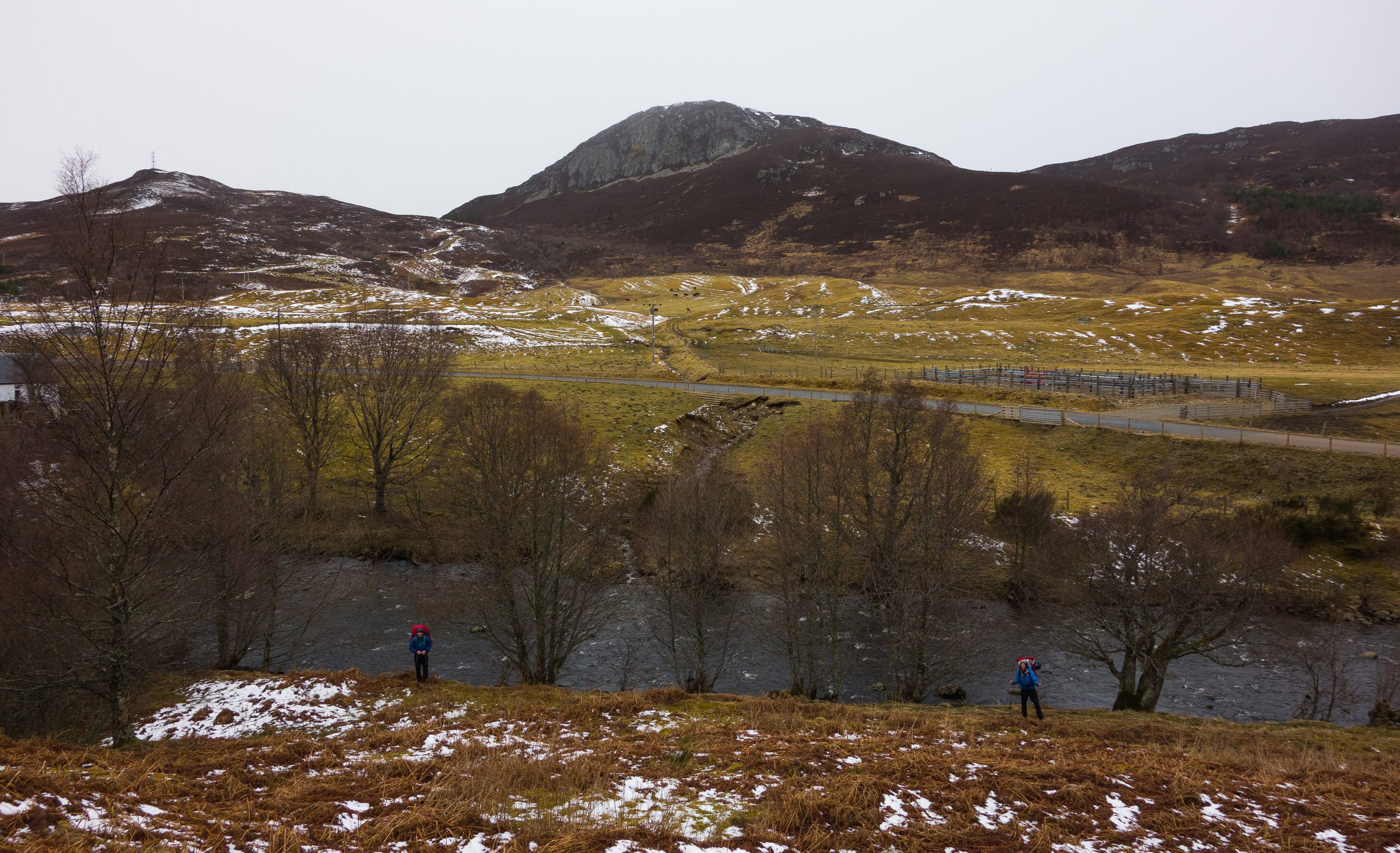
Transition complete. River is wider here but still pretty shallow

So we took on another route march for a couple of hours to get into Newtonmore. It was all along a cycle path next to a main road which wasn’t particularly interesting but did mean that we could put down a pretty solid pace and we were soon at the hostel in Newtonmore.
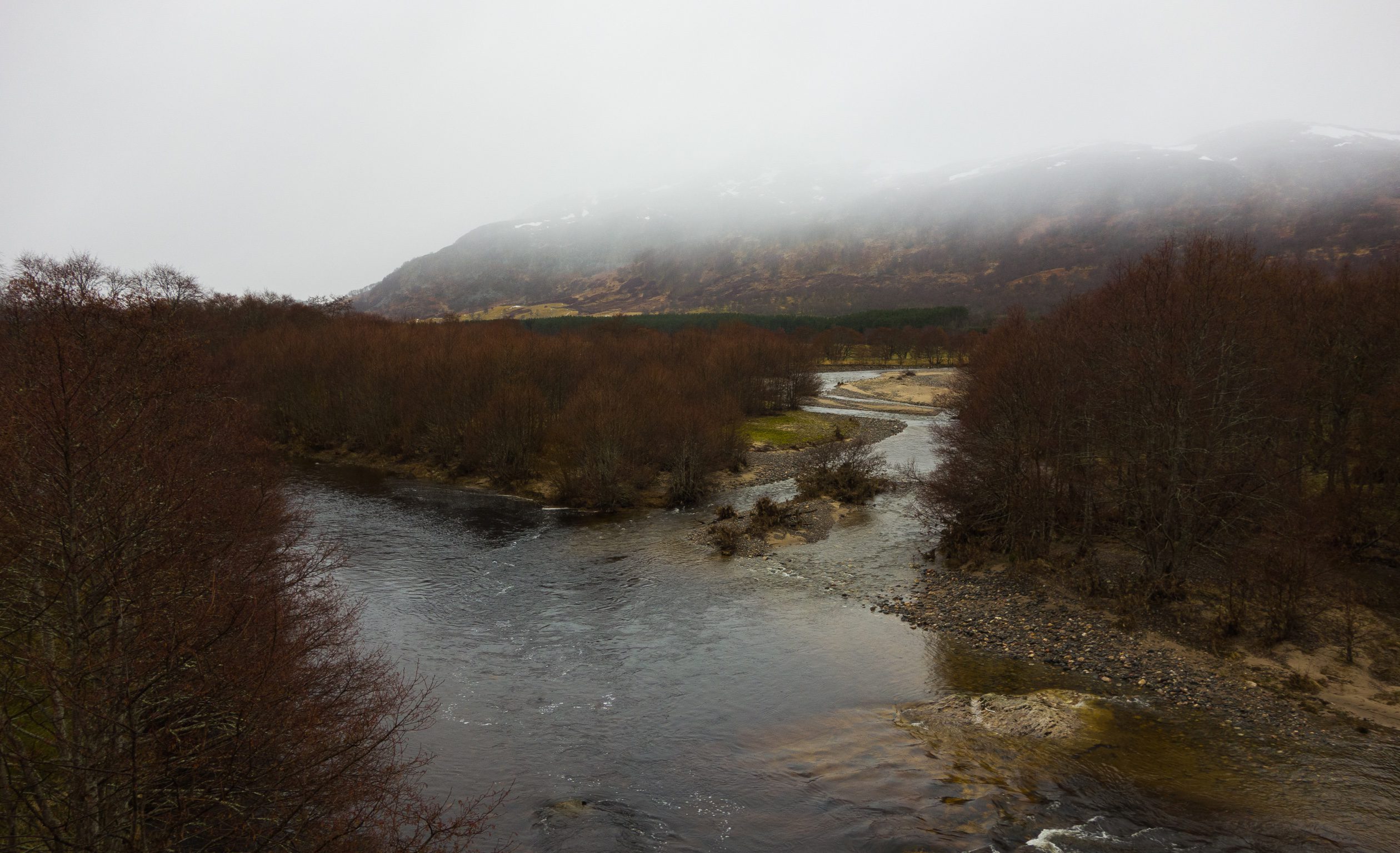
This is more what we were looking for: the Spey

The hostel was great, the drying room was very welcome as was the hotel bar across the road where we feasted and I started drinking strawberry beer for some reason (it was on offer), before we headed back over to sit round the fire, drink whisky and impress Austrian tourists with how manly we were (very).

The next morning the plan was to get down to the Spey and take it all the way to Aviemore, maybe stopping for lunch at Loch Insh on the way. In the original plan we had thought about taking a taxi from Dalwhinnie up to Kingussie or Loch Insh, but we were a day ahead of schedule and decided to keep going under human power.

We were finally on the Spey and it was a much better river for rafting than the Truim, the first hour or so was really enjoyable as we could sit and float downstream. It’s great to be able to just take a a break but keep moving towards the goal.
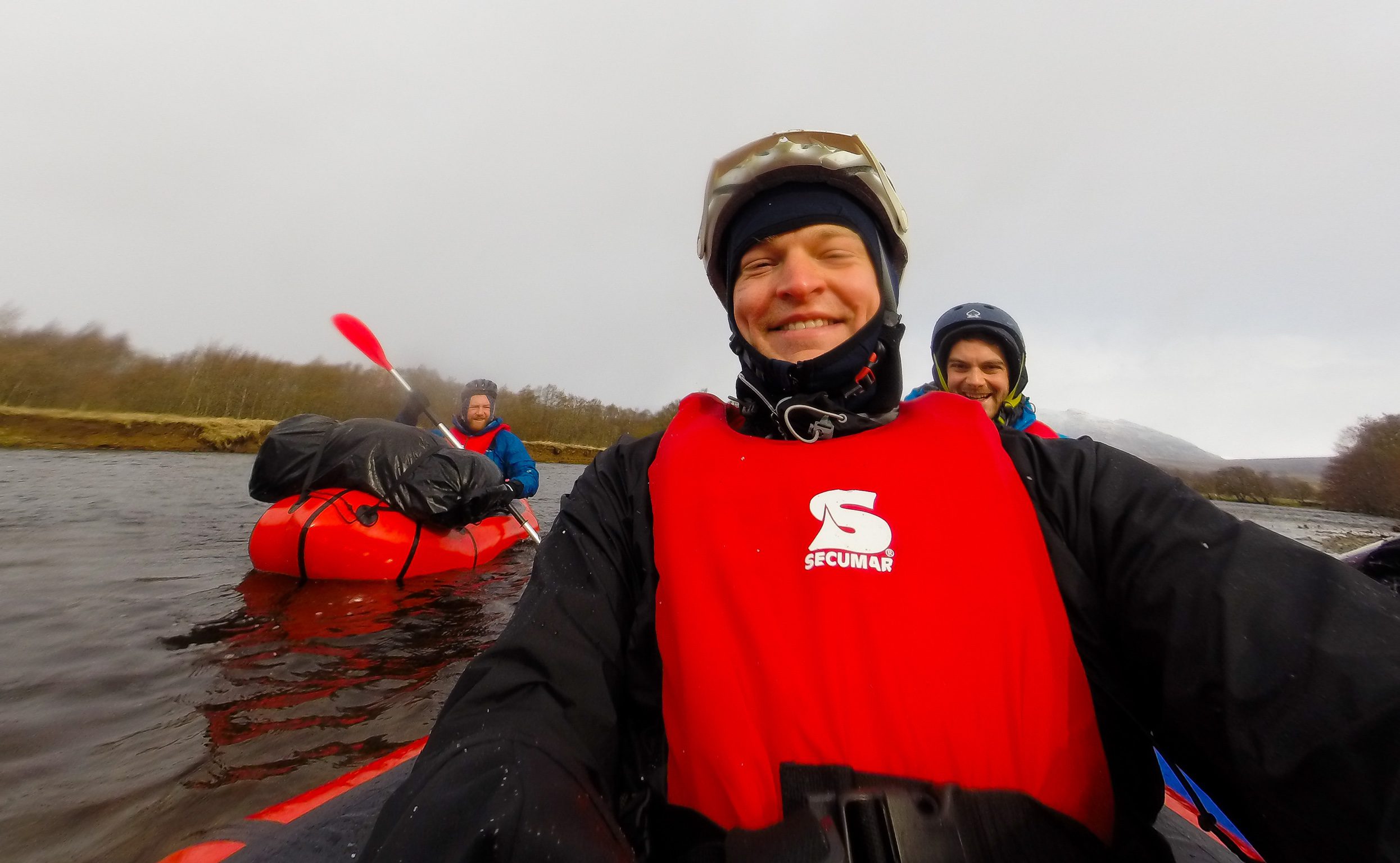
Great not to have worry about hitting the bottom

Rob had somehow managed to put a small hole in the top of his raft when packing it up one day so we had a small stop to repair it but repair it we did. Not easy to do in the snow but a combination of toilet paper and ethanol managed to dry the raft enough for the patch to stick.

As the day continued though the weather got steadily worse as the wind picked up and the snow showers became more and more intense. Due to the large tubes riding high of the water the rafts are not good in wind – great when it’s with you, but unless the river is a dead straight line (like Loch Ericht) then it can get pretty tricky. We persevered for a while until none of us was having any fun and we were finding it difficult to make progress. So it was time to transition and get walking again.
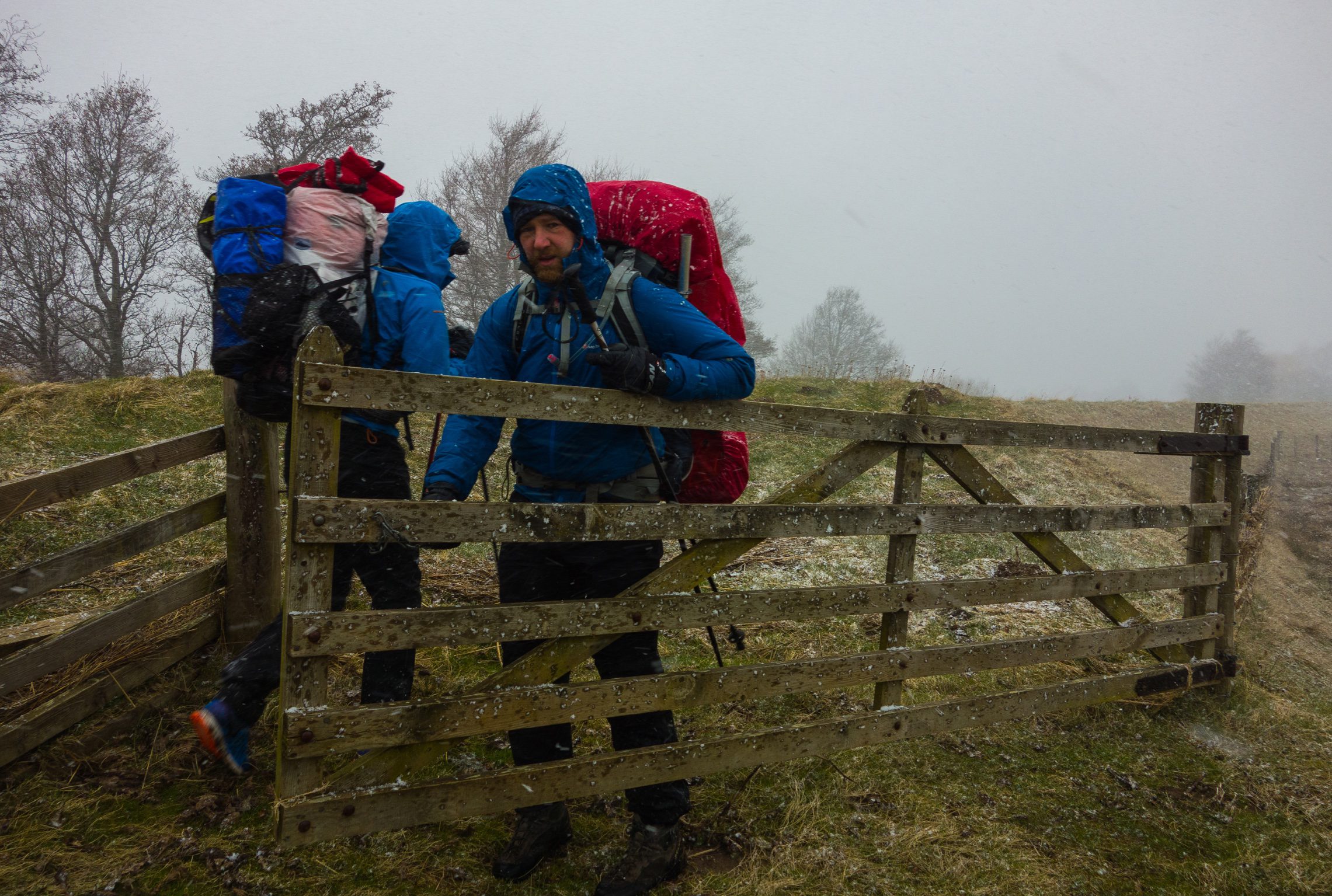
Scottish weather is ridiculous

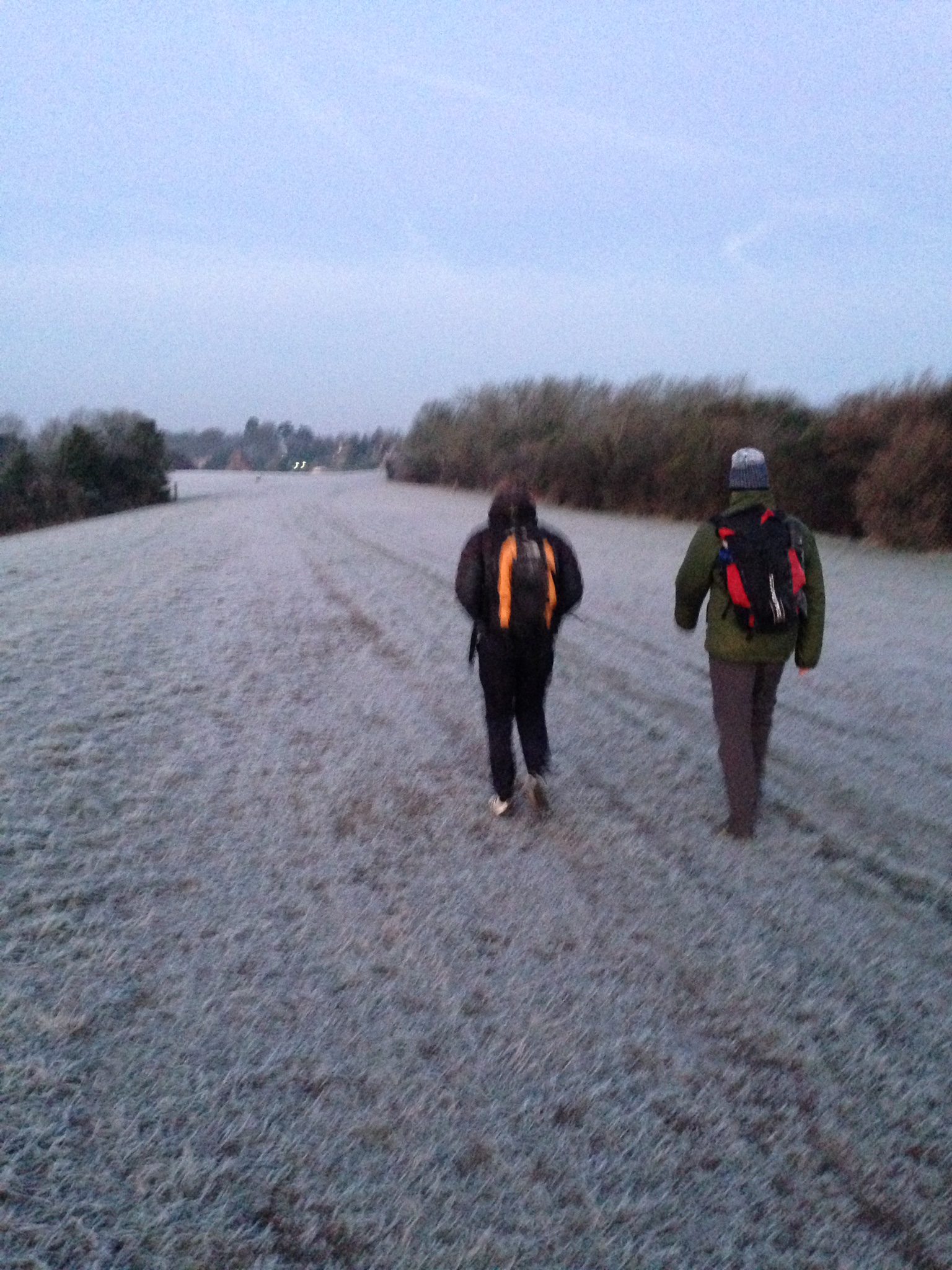
This was tough, the ground was soft and boggy and the weather alternated between snow and strong wind and bright sunshine. Scotland really is generous with giving you all of its weather. It was frustrating to have to follow the meanders of the river, but there was no way we could have cut across the softer lower ground. The last bit did involve finding a path through a pretty deep bog but we got through and eventually made it to Loch Insh around 3pm. We had a massive amount of food and a few beers in the sailing club cafe and as we watched the wind coming across the loch we decided that we could probably just get a taxi the last stretch to Aviemore.

It was a shame to not be able to cover the whole distance under our own power, but none of us really fancied trying to raft in that wind or walking alongside a road for 2 hours. Especially after burgers, macaroni cheese and pudding. It is amazing how fast a car is when you have been walking and rafting.

We checked in to the Old Bunk House in Aviemore and started to work out what we were going to do the next day. The weather for crossing the Cairngorms was looking dangerous so we needed to get some more information and potentially come up with a back up plan.
Packrafting 2 – Corrour to Dalwhinnie

Previously

Rob had ordered up some rafts for us from packrafting.de (cheaper to get them from there rather than Scotland for some reason) and booked tickets on the sleeper so we were definitely on.  Lots of discussion over email on what kit we needed and what we were all buying (basically lots) and we finally met up at my office after work on Friday to do our final packing with the rafts.

It was immediately apparent that these bags were pretty heavy and I think we were all surprised / scared just how heavy they were, no going back though… We had dinner at the Scotch Malt Whisky Society and then headed to Euston to catch the sleeper to Glasgow. Getting the bags onto the train was not easy and there was just about room for us in our bunk with the packs as well. Special mention here goes to the lounge car on the train and in particular the reasonably priced cheeseboard.

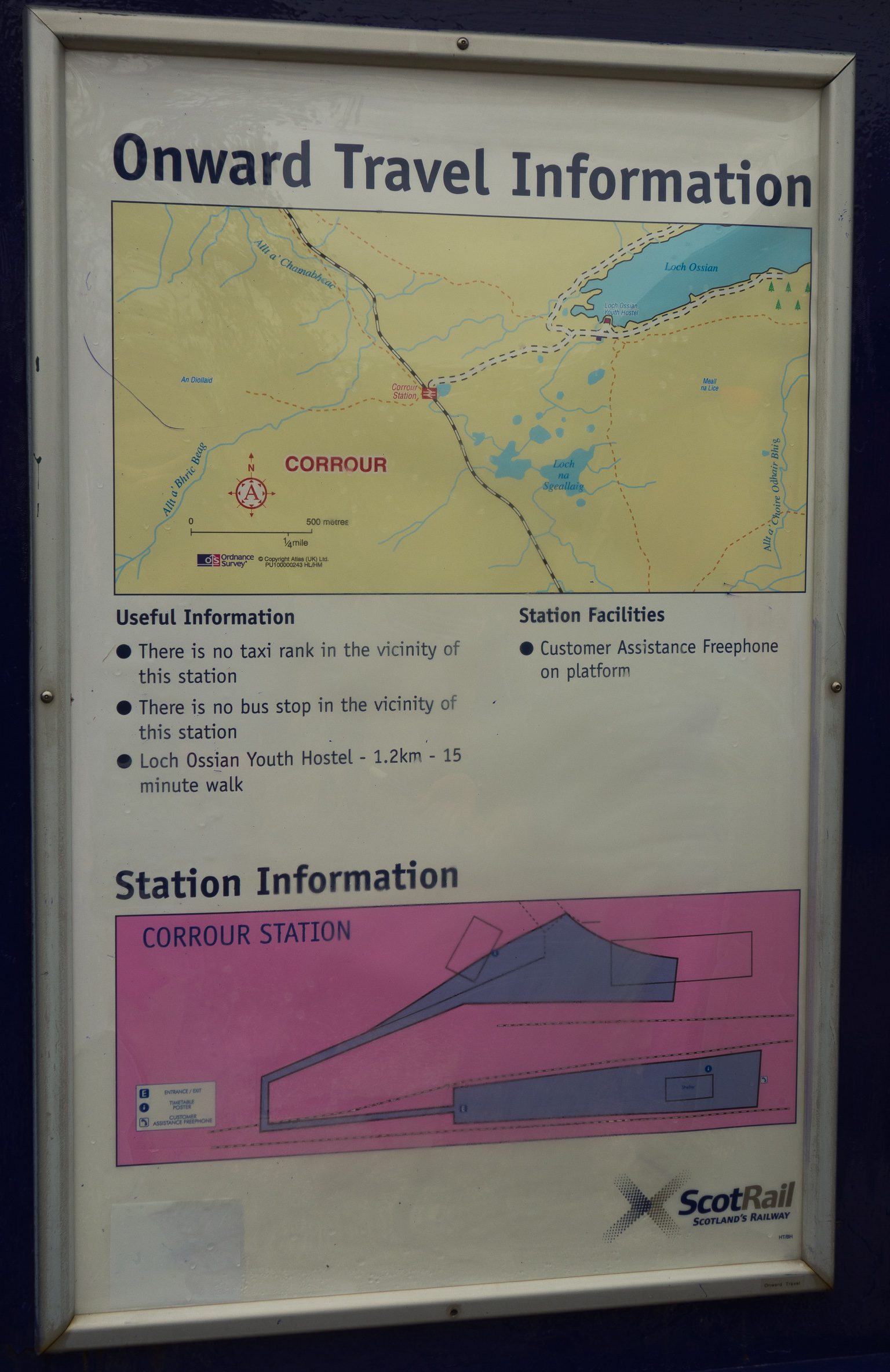
Changed train at Glasgow and on to Corrour. By this stage we were all nervous about stepping off: weather forecast was terrible, the packs were really heavy and we had a fair way to go before dark, but we did step off to be greeted by this fantastic sign at Corrour station:

You're on your own...
You’re on your own…

We walked for about 10-15 min until I noticed that Quiller had had enough of the heavy load and ditched his packraft. This did make the walking easier but would surely make the water-bourne sections more difficult.

Losing the raft would have been a bad start

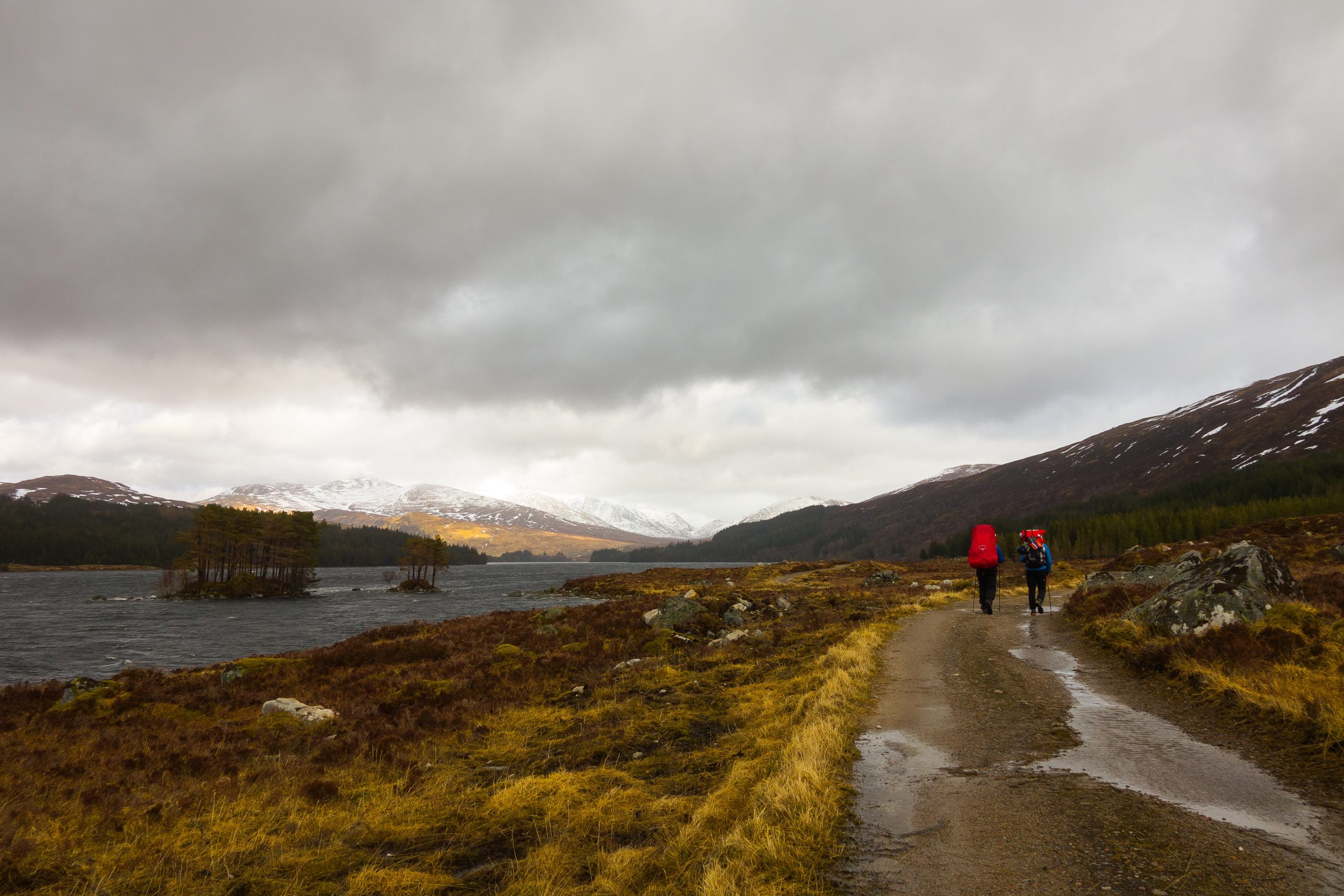
Back up to the full flotilla we settled into a decent pace and soon adjusted to the weight.  Scenery was fantastic and we were eager to get deeper into the hills. All pictures by the way are courtesy of Rob.Packrafting-6

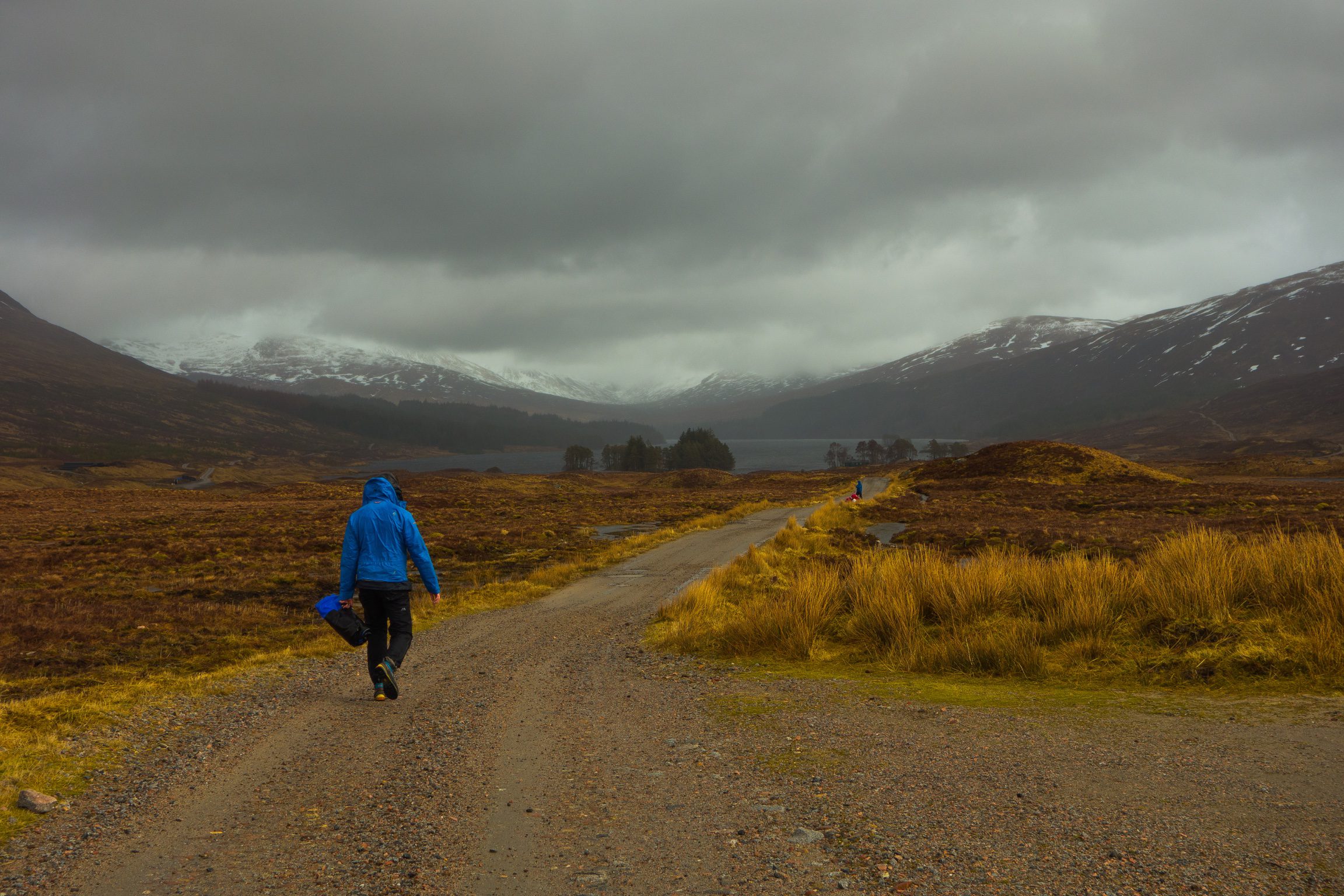
There was some construction work going on at the far end of Loch Ossian, putting in a new hydroelectric plant and we also saw a few people who were staying at the YHA on the loch. The works meant that though our map said that the path went across a river, getting across now actually meant a pretty large detour to get up to a point where it was fordable.

Not convinced by what Quiller's doing here
If only we had some sort of boat with us…

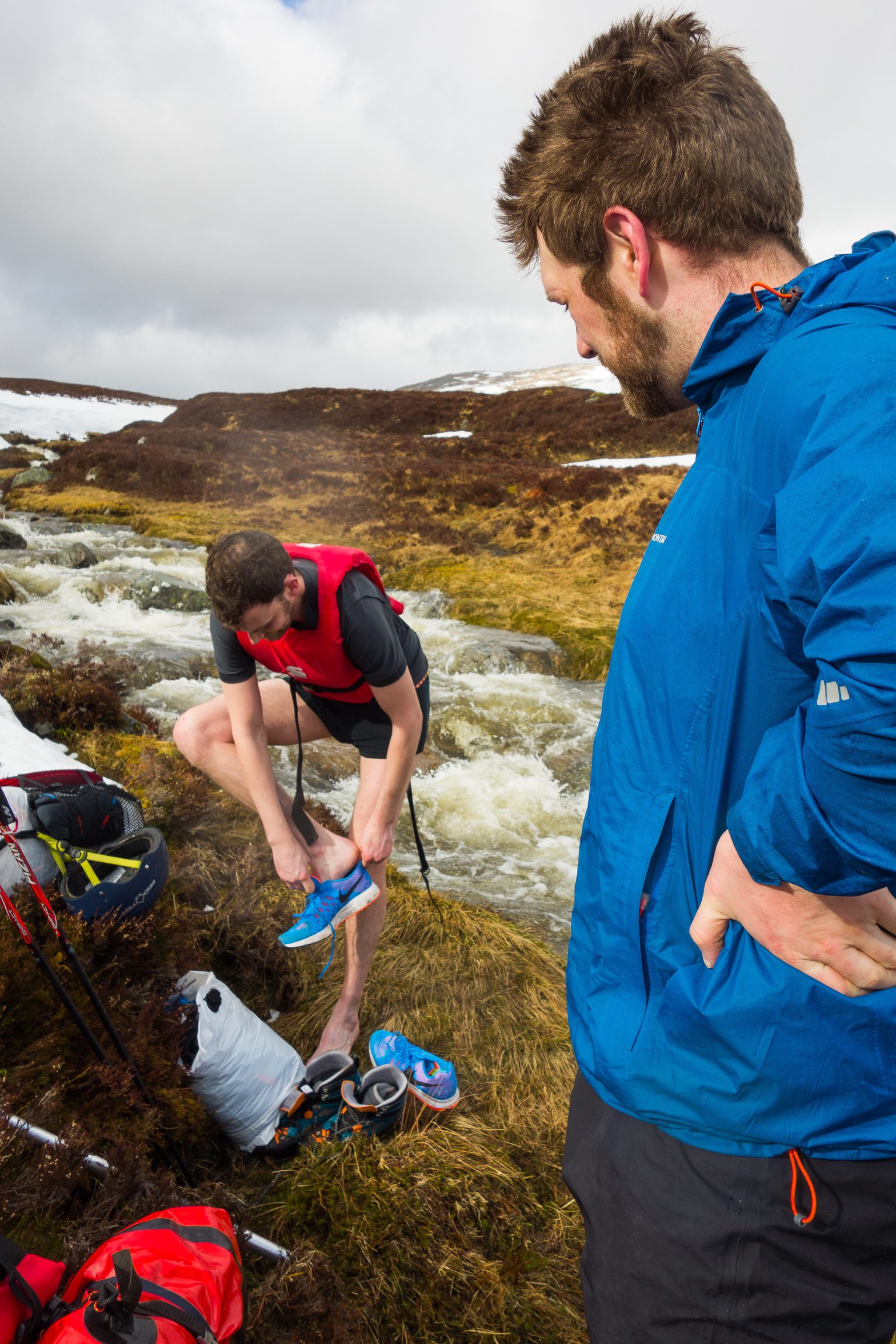
We were probably over cautious due to having just started and also the size of the packs but the river was flowing fast and was coming up to waist level in places. In the end we found a spot where it was a bit slower and shallower and crossing was reasonably straightforward, felt like an achievement though. Most of us kept our clothes on as well, not sure what Quiller’s up to in that photo.

Later on in the day I showed a lot less patience in walking straight through a river, this left me with wet boots for the rest of the trip and was pretty stupid (they would have got wet anyway though). It was a long afternoon of walking and the final stretch down to the bothy seemed to go on forever. We could see exactly where it was but it just didn’t seem to be getting any closer. Finally we reached it at around 7 I think, having walked pretty much solidly since about 11.

"The bothy's just down by the water there"
“The bothy’s just down by the water there”
Finally the bothy
Finally the bothy

We had the bothy to ourselves and the next morning all woke up with aching shoulders and legs. Luckily however the wind was in the right direction and not too strong so we inflated the rafts and set sail for the first time.

helmet wasn't really necessary
helmet wasn’t really necessary

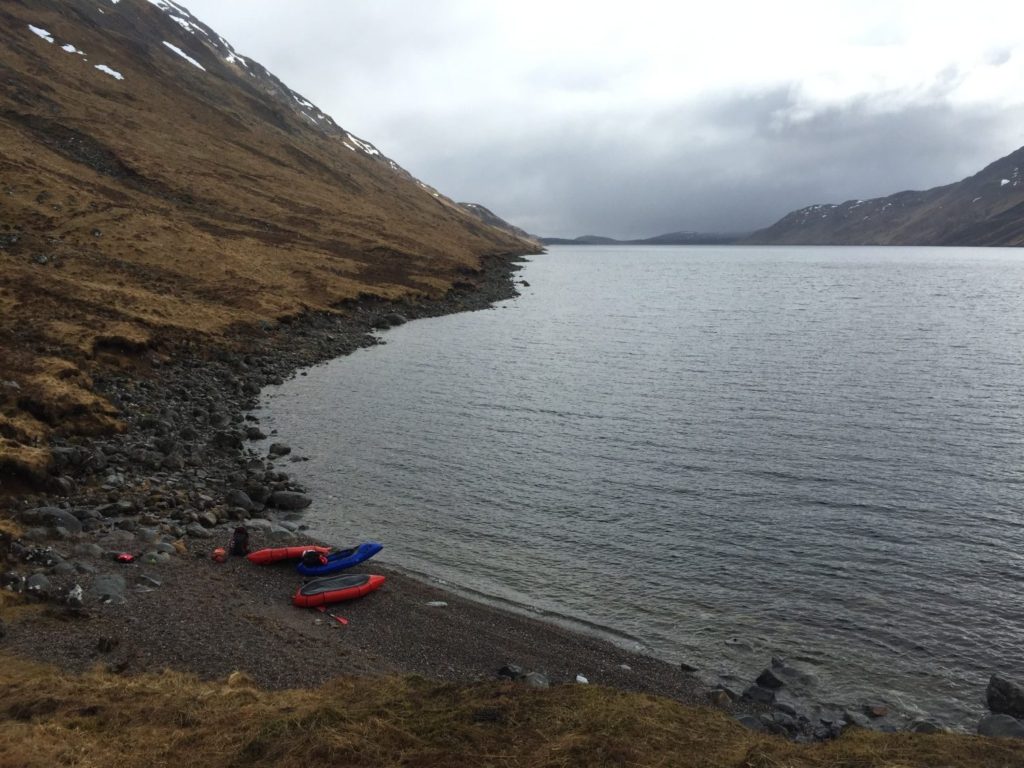
It felt a lot better to have the packs on the rafts rather than on our backs and breaking up the journey like this is one of the great things about packrafting. The wind was in the right direction to blow us up Loch Ericht, there was no one else to be seen and we even got some sunshine on occasion.

Packrafting GP-3We hadn’t got used yet to quite how generous Scotland is with its weather – it has a lot of different weather options and likes people to experience all of them, preferably during the same day. So we would think about stopping during a bright patch, only for it to immediately start snowing.

We were planning to wild camp somewhere near the Loch that evening but after we stopped basically at the helipad of Ben Alder Lodge (a very strange place) we realised that with a couple of hours of walking we could stay inside in Dalwhinnie.

Looking back towards Ben Alder Lodge

This was a pretty tough route march but I was very glad we did it. The Dalwhinnie bunkhouse had clean beds, showers, cold beers and an unbelievable breakfast the next morning. The owner couldn’t have been happier to see us a day early and looked  after us very well. Next morning started with a visit of the distillery (would have been rude not to) although tours were booked up due to the arrival of a coachload of welsh indian visitors which we didn’t expect. The bottle of triple distilled Dalwhinnie served us very well on the trip, delicious whisky which I highly recommend. The plan was then to raft along the river Truim to Newtonmore, and this was the first real test of the rafts and our rafting skills…


Packrafting through Scotland – the beginning

For a couple of years now I’ve been reading about packrafting and thinking of how to get into it, my friend Rob (who came on the January microadventure) has been banging on about it for ages. We made it up to Aviemore in November one year (2012?) hoping to do a packrafting course with backcountrybiking.co.uk but their insurance wouldn’t cover us at that time of year and we ended up going kayaking instead. We’re all getting older with other commitments intruding into our lives and maybe this spurred Rob around New Year to send an email declaring 2015 as the year of the packraft:

Lads – I think 2015 is going to be the year of the packraft.
What would be your appetite to try a week in Scotland in late April / early May? Starting in the West, making our way East….I’m open to doing either packrafting (walking and rafting) or even bike packing (cycling and rafting).
Nothing set in stone yet, just wondered whether this is something anyone would want to have a crack at.
https://www.youtube.com/watch?v=d5LuvLA4W08 – Packrafts in action, although I don’t plan on running any real hardcore whitewater

I answered the rallying call along with another friend of ours from uni, Quiller and we started to put together a plan. After a couple of afternoons looking through lots of maps, plotting bothy locations on Google Maps and Bing Maps and reading river guides we had a potential route. In hindsight this route was incredibly ambitious, it’s very easy to say we might as well knock off some Munros while we’re there, but these sorts of thoughts disappeared pretty much as soon as we tried on our fully loaded packs. We also massively underestimated just how severe the weather could get in the Highlands in April and we did not even attempt to get over the top of any Munros.

Rob got in touch with David Hine to ask for his view on our plans. David has some incredible trip reports on his blog and was a big inspiration in us actually getting this trip organised. He was very helpful and wrote Rob a long reply, which was generally supportive although sounded some sensible notes of caution:

Snow and ice in general can still be extensive during April in the Cairngorms…not that that’s a reason to change your plans, just be prepared for it,…that can also make some parts of the rivers more threatening….

So the plan was to leave work on Friday and get the overnight sleeper train to Corrour, walking from there to Ben Alder Bothy on the Saturday. Sunday we would head up towards Culra Bothy (annoyingly closed due to asbestos) and wild camp. Monday would take us to Dalwhinnie before on Tuesday getting a taxi / bus / train towards Loch Insh and then rafting into Aviemore. Wednesday we head south towards Braemar, getting there on Friday. Saturday we would meet up with my wife and her sister and raft along the Dee towards Balmoral before heading over to my parents at Aviemore. That was the plan, what we did deviated from that slightly, route map here.

The trip was fantastic. I will explain in later posts what made it fantastic and also what I would do in the future to make similar trips even more fantastic.

Taking a break after our first packrafting session

Settlers of Catan + Man of Aran

Founding the new country, working hard

Settlers of Catan was the gateway game for me and the one the made me realise that boardgames didn’t have to be rubbish fun traps. It’s probably the most well known ‘good’ board game now and for good reason. It’s pretty easy to pick up, every player is involved a lot of the time and there are a lot of different ways to win meaning that you often have to change your strategy throughout the game. It’s also unusual in that the board is a collection of hexagon tiles which are arranged in different ways each time, so each game is different.

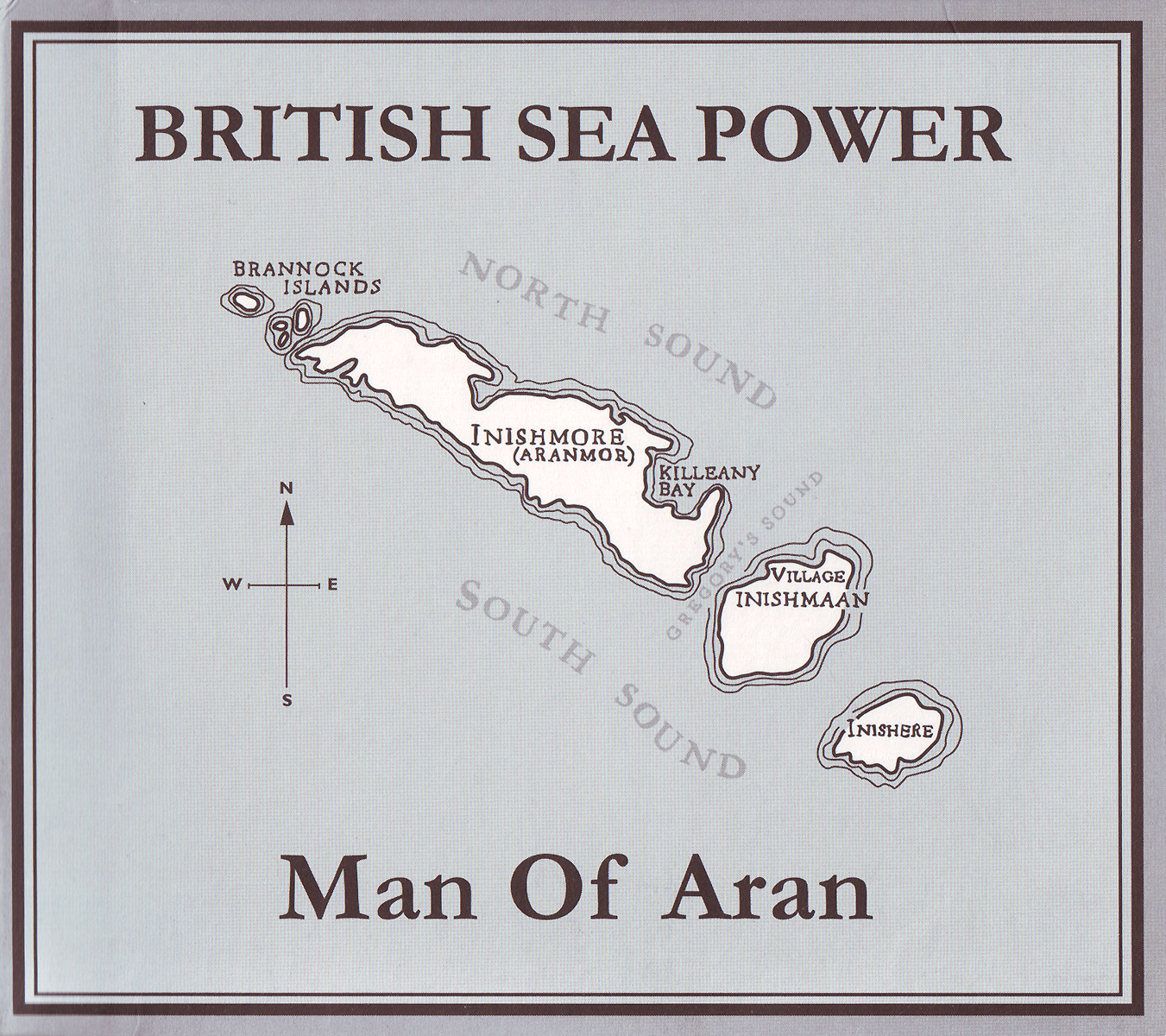
Catan is all about colonising new land, making bricks, bringing in the wheat and chopping down wood. The music choice for this is by one of my favourite bands ever: British Sea Power.

British Sea Power are a very rural band and many of their songs are about nature (sample song titles: “Apologies to Insect Life”, “Favours in the Beetroot Fields”, “Oh Larsen B”, “The Great Skua”). They’re incredible live, I saw them at Oxford Brookes and most of the crowd had attached foliage to their clothes. The band climbed around the scaffolding, at one point I think there was a guy in a bear suit, it was fantastic.

They’ve also done some interesting soundtracks for some great documentaries. Highly recommended is “Happiness” about a child in Bhutan who goes from his village with his dad to bring back a TV which have just been allowed into the country. This choice though is “Man of Aran”, a 1934 film for which British Sea Power wrote a new soundtrack. It’s epic and fits perfectly with the game. It always seems like the tension picks up in the music at just the right time. The film is great as well.

So get Catan out, and put Sea Power on.

Brecon Glamping Microadventure

I think this counts as a microadventure. It didn’t involve wild camping or sleeping outside but there was a fair amount of walking, some of it in pretty terrible conditions so I’m counting it as the February entry in the year of adventure.

We’d been given a voucher for Canopy and Stars by some friends for our wedding and had finally gotten around to actually booking somewhere. A lot of places on that site need you to book for a week or a minimum of 3 nights which is a bit frustrating but eventually we found somewhere after speaking to the company.

We booked two nights at the Shepherd’s Hut at Argoed, near Brecon

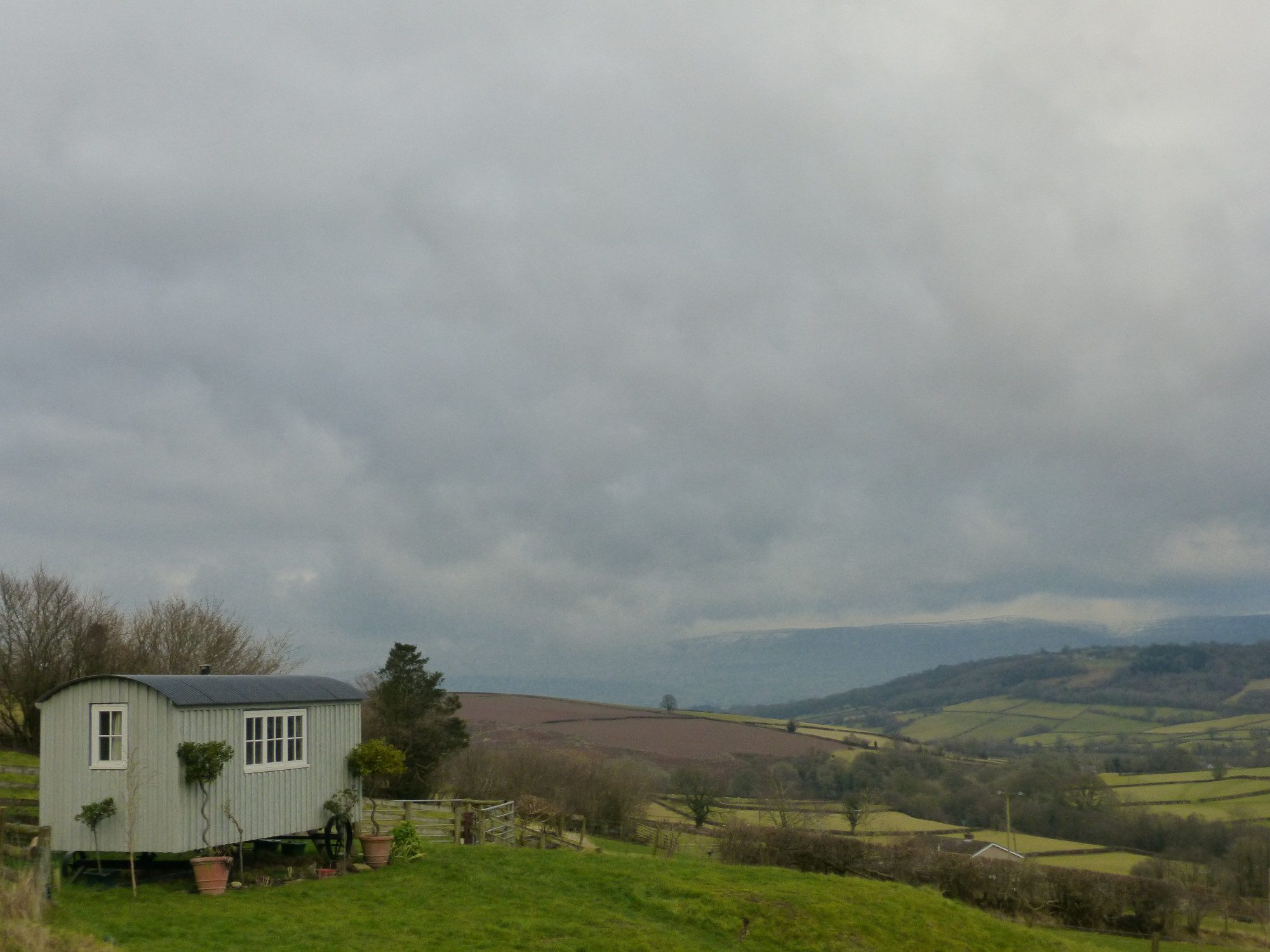
The Shepherd's Hut
You can’t see the massive house just out of shot, but the hut is far enough away to feel private
The inside of the hut
Very cosy, incredibly warm with the fire + underfloor heating

So plan was to leave work earlyish on Friday, get the train out to Reading where we would pick up a hire car and then drive to Brecon. I got the hire car through Budget, a 10min walk from Reading station for the great price of £41 until Sunday afternoon. There wasn’t a problem or extra charge with dropping it off out of hours either so this worked out perfectly and something I’d definitely look at doing again.

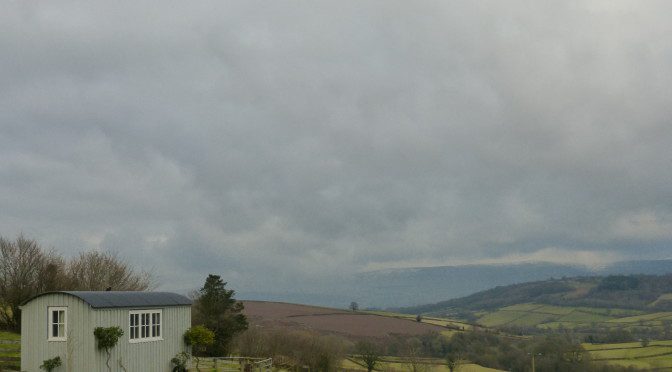
Saturday we got up fairly early to a cooked breakfast in the main house and then drove into the park to attempt a fairly ambitious walk around the Brecon Beacons. The weather was not good, it had been snowing the past few days and visibility was very poor when we got out of the car. I was excited and up for the challenge of some more difficult navigation and conditions but I probably underestimated just how bad it could be.

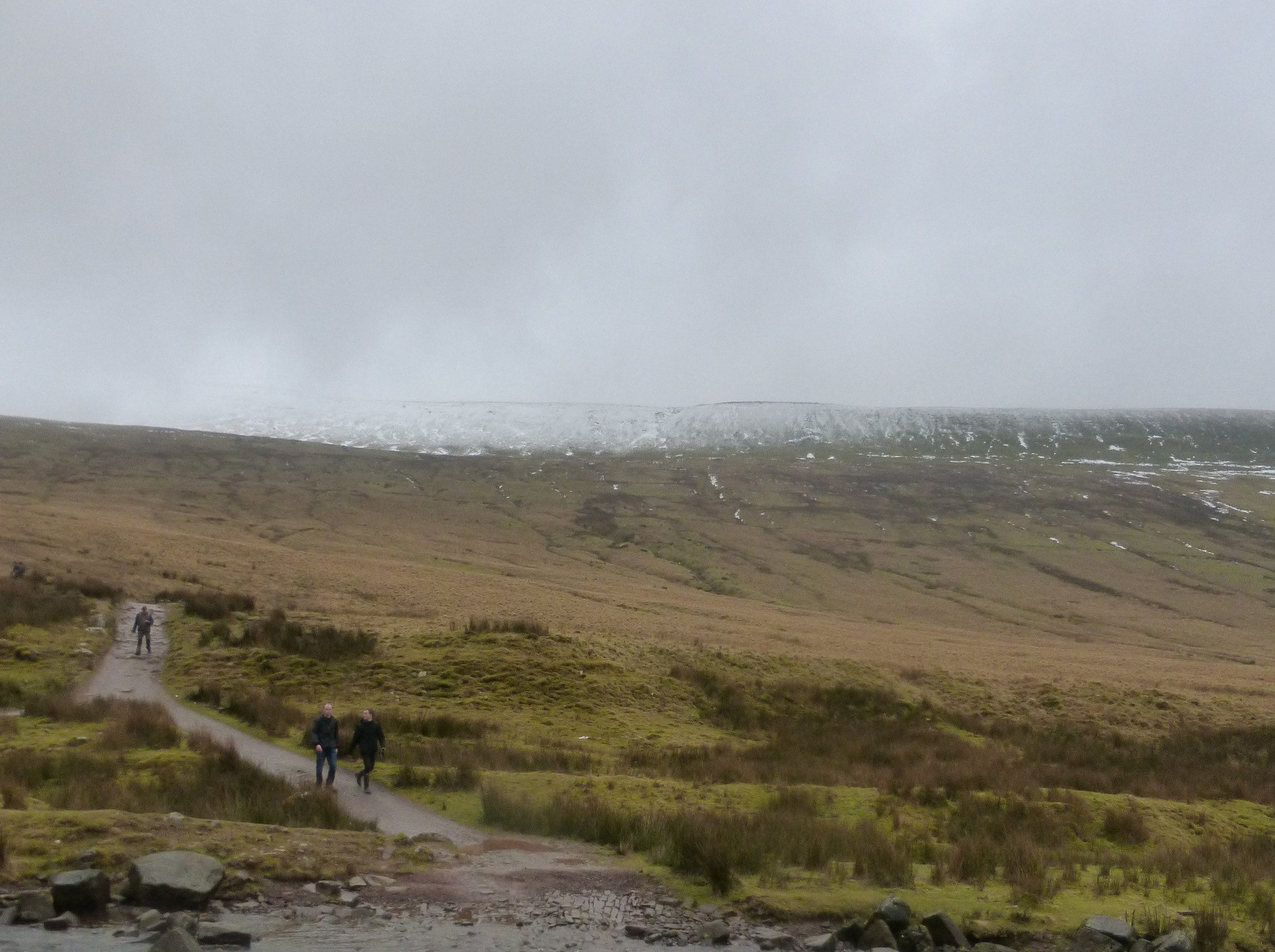
Walking on a bearing
Not a huge amount to work off here…

As we got up to Corn Du the wind was coming in very strongly and the snow was quite thick. I don’t have any photos as neither of us really wanted to hang around and take photos. Sarah had injured herself earlier slipping on the snow and so we decided to come down off the hill and cut the walk short. We walked down past a lot of people heading up in jeans and trainers – not sure they knew what they were letting themselves in for. Everyone else along the ridge was in full Goretex plus crampons. Once you got down out of the cloud the weather was pretty reasonable though, amazing the difference up at the top.

That cloud contains bad things
Looks ok down here…

So back to the hut and then later we walked down to the Felin Fach Griffen for dinner. This is a great gastropub with fantastic food which was a lot better than I was expecting in a random Welsh village.

The next day the weather wasn’t much better so we decided on a low level walk to the waterfall at Sgwd yr Eira. This is a big waterfall which you can actually walk around the back of and was good to go and see. It was interesting seeing the remains of gunpowder works along the way as well and to see the different varieties of landscape. This walk worked out a bit longer than expected though as we took a wrong turning at one point, deceived by what looked like a place to cross the river. After weighing up our chances of wading across or building some sort of bridge or stepping stones we doubled back on ourselves, adding about an extra 45min to the walk. This was a lesson to carry more food than you think you’ll need – by the end I was starving. However, I can vouch that a long walk outside will do wonders for hangovers brought on by excessive wine, beer, food and whisky.

So despite the lack of any camping, I’m going to call this my February microadventure. I’ll be looking for an excuse to go back to the Brecon beacons as we had a great time.

What would I do differently next time?

  • Give more respect to the weather forecast and adjust plans where necessary – should have come up with a different walk for the Saturday
  • Be sure on where river crossings are
  • Carry more food than I think I’ll need

Burns Night Toast to the Lassies – Script & Tips (Updated for 2026)

The Anatomy of a Successful Toast (A Data-Driven Approach)

I am not a natural public speaker. When I was asked to do this, I was terrified of either boring the room or accidentally offending someone. So, I did what I always do: I analyzed what makes a speech work and built a structure to minimize the risk of failure.

I looked quite extensively online for tips and example toasts but nothing was that good so, in the hope that it might help someone else out here’s the toast that I gave, or at least the toast that I wrote beforehand. I definitely didn’t read this out verbatim, I’d had a few beers and was feeling more creatively inspired in the delivery than when I wrote it – I recommend this approach!

If you are writing your own version, here is the 3-part formula I used:

1. The “Low-Status” Opener

The Goal: Lower expectations immediately.
The biggest mistake people make is trying to be a stand-up comedian. You don’t need to be funny; you just need to be self-aware. By starting with a joke at my own expense (my lack of preparation, my nerves, or my Google search history), I got the audience on my side early. Once they are laughing with you (or at you), the pressure drops.

2. The Pivot to Sincerity

The Goal: Make people think, enjoy the contrast.
A “Toast to the Lassies” is traditionally a roast, but if you stay in “roast mode” for 5 minutes, it gets awkward. You have to have some light and shade. If you are speaking in front of people, there is a chance to change how they think about something, and it’s worth taking that opportunity. So I made sure to have a sincere element. People then enjoy the jokes after more as well.

3. Closing and Call-backs

The Goal: Leave before they want you to, and tie things together.
I timed this speech to be under 4 minutes. In the history of Burns Suppers, nobody has ever complained that a speech was “too short.” Maybe this is just me, but I really enjoy callbacks, referencing something that was mentioned earlier: Arrested Development is full of these, also Stewart Lee’s stand-up. It makes me think that the person has thought about this, and gives me an extra satisfaction .


Good evening Ladies and Gentlemen. For those who don’t know me my name is Rob Mitchell and I play second row for the 1st XV. I also compile the statistics for the 1st XV, noting how many appearances players have made, and so because I love statistics I note that this is the third Burns night I can remember attending here. Since my first appearance I’ve learnt not to wear a kilt to these occasions and John Hines has learnt not to ask me in front of assembled dignitaries to prove whether I am a true Scotsman in my wearing of said kilt…

So when David Dick asked me to give the Toast to the Lassies, I said I’d think about it but wasn’t sure if I could do it… he then thanked me for agreeing to do it and here we are. I have to confess that despite being born in Glasgow and with parents living in Aberdeen I had to go and look up what was expected from the Toast to the Lassies. My hopes were immediately dashed when I realised it had nothing to do with those incredible dogs who save so many children from abandoned mine shafts every year, or the Guildford RFC backline.

Scotland still being just part of Britain I went to the BBC site which describes the Toast to the Lassies as “the humorous highlight of any Burns Night”. I’m not sure who wrote that but no pressure I suppose… at least not if you’ve spent the rest of this evening sitting on Rory Andrews’s table.

The BBC goes on to say that this toast “is designed to praise the role of women in the world today. This should be done by selective quotation from Burns’s work and should build towards a positive note.” I don’t know if that means I should start on a negative note or something. However one important point that the BBC does not mention is that in preparation the speaker should spend 80min running round a muddy field getting his head kicked in, followed by 4 hours of aggressive drinking, but we can all read between the lines here.

Here at Guildford we are lucky to be able to count on the involvement of many women, from the players in the mighty Gazelles, to coaches, physios, administrators, volunteers, bar and catering staff and supporters. Not to mention those partners of players who put up with weekend disruption as Saturdays (or Sundays) are spent playing and then the rest of the weekend involves their partner lying around in pain and asking for back rubs. I’m glad and proud to be part of a club which has such an active involvement from the other 50% of the population.

So on to Robert Burns. He was a big fan of women but however not such a big fan of responsibility, commitment or the withdrawal method and is thought to have fathered somewhere between 12 and 16 children with at least 4 women before he died at the age of 37. For a fan of statistics such as myself the implications of that are pretty mind-boggling. Assuming that there were no twins, that’s 1 child every year since the age of 20.

I’ve never really read much Robert Burns but I started looking through his work to prepare some of those selective quotations that the BBC recommends and was struck by how alive a lot of those poems and songs felt. You can really get a sense of the person behind the writing and the 16 children by 4 women in 20 years seems less outlandish. I am no Burns scholar but reading some of this stuff and picturing the man behind it, it seemed like there were three types of writing that Burns did.

First up are those poems where Burns is delighting in his conquests and showing what a lad he is. This one is thought to be inspired by Elisabeth Paton, a servant girl who worked in the Burns household:

My girl she’s airy, she’s buxom and gay,
Her breath is as sweet as the blossoms in May;
A touch of her lips it ravishes quite.
She’s always good natur’d, good humor’d, and free;
She dances, she glances, she smiles with a glee;
Her eyes are the lightenings of joy and delight:
Her slender neck, her handsome waist,
Her hair well buckl’d, her stays well lac’d,
Her taper white leg with an et, and a, c,
For her a, b, e, d, and her c, u, n, t,
And Oh! For the joys of a long winter night!!!

The second type of verse has a long lineage and was all too easy for a rugby player to recognise. No doubt many here are familiar with the story of the man who used to have a retail job in Chicago but lost it due to many misunderstandings with female customers and the items they came into the store looking for. Or the joys of being a Rifle Ranger, or the bear that I know that you don’t know, and so on and so on. If you were in the vicinity of the A3 between Gosport and here this evening it’s possible you may have heard some of these stories set to music…

It’s impossible to read something like Coming through the Rye (chorus:

O gin a body meet a body,
Comin’ throu the rye:
Gin a body fuck a body,
Need a body cry.)

Or the fantastically crude “Nine Inch will please a lady”:

`Come rede me, dame, come tell me, dame,
`My dame come tell me truly,
`What length o’ graith, when weel ca’d hame,
`Will sair a woman duly?’

The carlin clew her wanton tail,
Her wanton tail sae ready
I learn’d a sang in Annandale,
Nine inch will please a lady.

and not imagine Robert Burns and his mates getting pretty severely boozed before launching into drunken renditions of these and several others.

I’ve been a bit coarse here, and it’s not gone down as well as I’d hoped, so the BBC says that this toast should build towards a positive note (John Hines might be wishing that he’d asked me to prove my Scots heritage instead now…) I’d like to look at the final category of Burns’s work, those poems which go furthest to explain the multitude of women he was involved with. It is easy to imagine the average standard of wooing from farmers in 18th Century Ayrshire and then compare the stuff that Burns was coming up with. Maybe there were a load of outstanding poets back then, but much like playing for Guildford before I started recording statistics – if no-one records it then did it even happen? So imagine the success that someone would have with verses like these from “O Saw ye Bonie Lesley”.

To see her is to love her,
And love but her for ever;
For Nature made her what she is
And never made anither.

Thou art a queen, fair Lesley,
Thy subjects we, before thee:
Thou art divine, fair Lesley,
The hearts o’ men adore thee.

So to conclude, would you please be upstanding and I’d like to finish with some final words from Burns as we toast to the lassies:

Old Nature swears, the lovely dears
Her noblest work she classes, O:
Her prentice hand she tried on man,
And then she made the lassies, O.


If you’re looking for some whiskies, have a look at this other post:

Best Brompton Improvements

I’ve been riding my Brompton for about 7 years now, commuting to and from work about 25min each way. I’ve also done a few longer trips with it including a trip from London to Aberdeen, riding about 60 miles each day. So I think I’ve put some pretty serious mileage on it and have learnt a bit about what on it is good and what can be improved.

When I bought it, my Brompton was an M6L. That is it had the classic U shaped handlebars, 6 gears and lights and a rear rack. The lights were the bottle dynamo type, powered by a small wheel rubbing against the rear tyre and that was the first thing I got rid of. I didn’t really want the L type but I needed to get the bike in a bit of a rush (before the Scotland trip) and that was what was available at a reasonable price. The bottle dynamo is a waste of time, so much so that I think it has been discontinued. It would often flick on when going over a bump and seemed to make cycling a lot harder. LED lights are cheap and the batteries last a long time so they are a much better option.

Having said that, one good thing about the dynamo light is that the front light is mounted down near the wheel and is not obstructed by any luggage you might have. When using handlebar lights in conjunction with a large bag, the bag can obstruct the light, meaning that there is a shadow about 9 feet in front of you.

As mentioned above, LED lights are cheap so I have several on my bike. I keep a couple of Electron Backupz on for emergencies and as my main lights I have a Cateye Nanoshot on the front and the Moon Gem 3.0 on the back. Both of these are USB rechargeable which is essential for a commuter and the Nanoshot is bright enough to illuminate a dark road. I’ve had them for a couple of years and they are both great.

Another major improvement I’ve made is swapping out the basic foam grips for some Ergon GP3 grips. I cannot recommend these enough and Brompton should be offering them as an option. You have to cut them down to get them to fit (and it helps if you have the 2014 brake levers with the narrower bracket) but they will fit and not interfere with the fold, at least if you have the rack. They are incredibly comfortable and I can’t imagine going back to something else. On the trip to Scotland, my hands probably suffered more than anything and I wish I had had these then.

I was so impressed with the grips that I went back to Ergon for some pedals and got a pair of their PC2s. I only actually use the right pedal as I keep the folding one on the left but you can’t buy just one pedal… The main benefit of these is that they are flat – I found the standard Brompton pedal could tear up my shoe a fair bit, the problem is less on the folding pedal as the spindle area is larger.

This one might seem minor but has made a difference: a metal chain guard from Tiller Cycles. I was having issues with my plastic one coming loose, falling off and cracking so after seeing these on My Orange Brompton I bought one, and again it’s great. Makes the bike look better and I never worry about knocking it loose with my shoe.

Other changes I’ve made have mainly been to take advantage of the development that Brompton is doing. One of the best things about Brompton is that you can buy every individual part should you so wish so it is easy to upgrade and replace items. So over the years I have…

  • Swapped the standard tyres for Marathon plus on the back and Kojak on the front, then just Marathon plus on both as punctures are a real pain. The old Marathon plus seems to be better than the new one…
  • Upgraded the brake levers to the ones Brompton brought out in 2013-14. These are much much better
  • Upgraded the hub to the wide range version. To be honest I didn’t notice much difference with this and probably wouldn’t bother again. You don’t need as many gears as you think
  • When I got the new hub on, I had a new style rim put on as well. I’m pretty heavy and I kept breaking spokes on the rear wheel but since having the new rim (which is meant to have more sympathetic angles for the spokes) I haven’t had any problems
  • Replacement rear triangle when the bike shop spotted a crack in it, this Brompton replaced for free (credit to Simpsons Cycles for spotting the issue)
  • Added the EZ wheels to the rear rack. Again these are much better than the standard ones

Bromptons are fantastic machines, but they can be improved. If you do one thing to yours put the Ergon grips on. It is very easy to do and a step change in comfort when cycling, especially if you are like me and have the seat above the level of the handlebars, resulting in a lot of weight going through your hands and wrists.

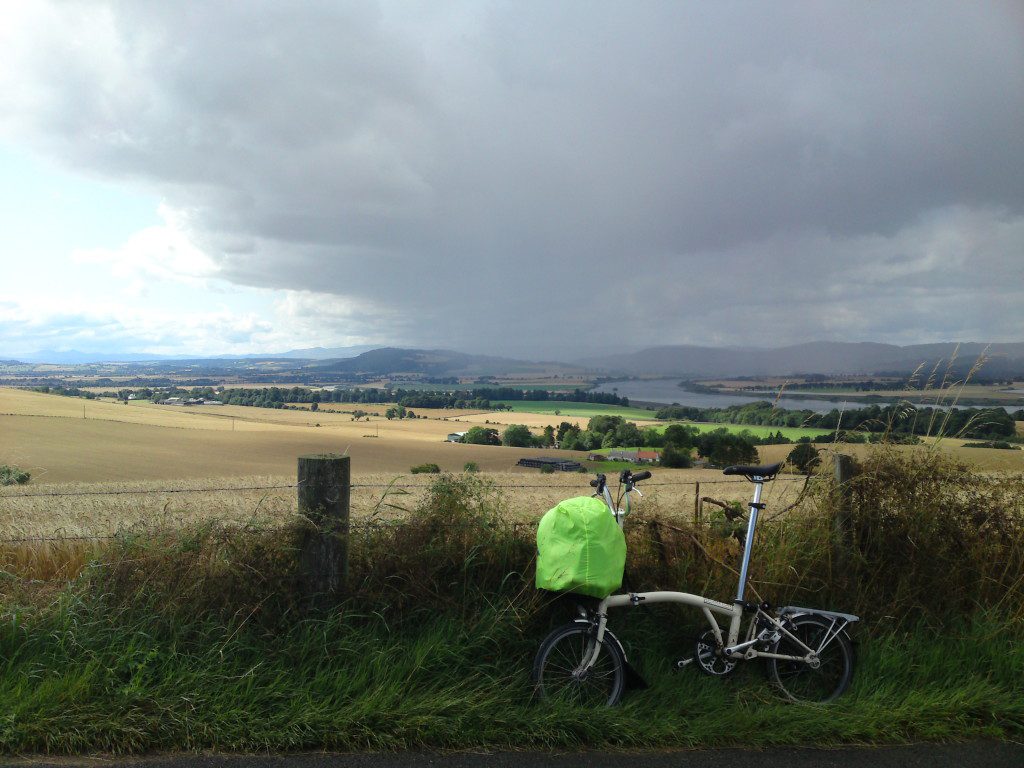
Brompton on the way to Aberdeen
Coming up to Dundee I think – before I replaced the grips (or much else)

Whisky Fuelled January Microadventure

This was in some ways the most ambitious microadventure I’d attempted to date. Firstly it was mid-week (Thursday night) so more logistically complex in having to leave from work and go to work the next day. Secondly it was the middle of January and some of the coldest nights of the year. All previous microadventures having been done in the summer at the weekend, this would be a couple of important firsts. To allow for this most other elements of the plan were kept as simple as possible.

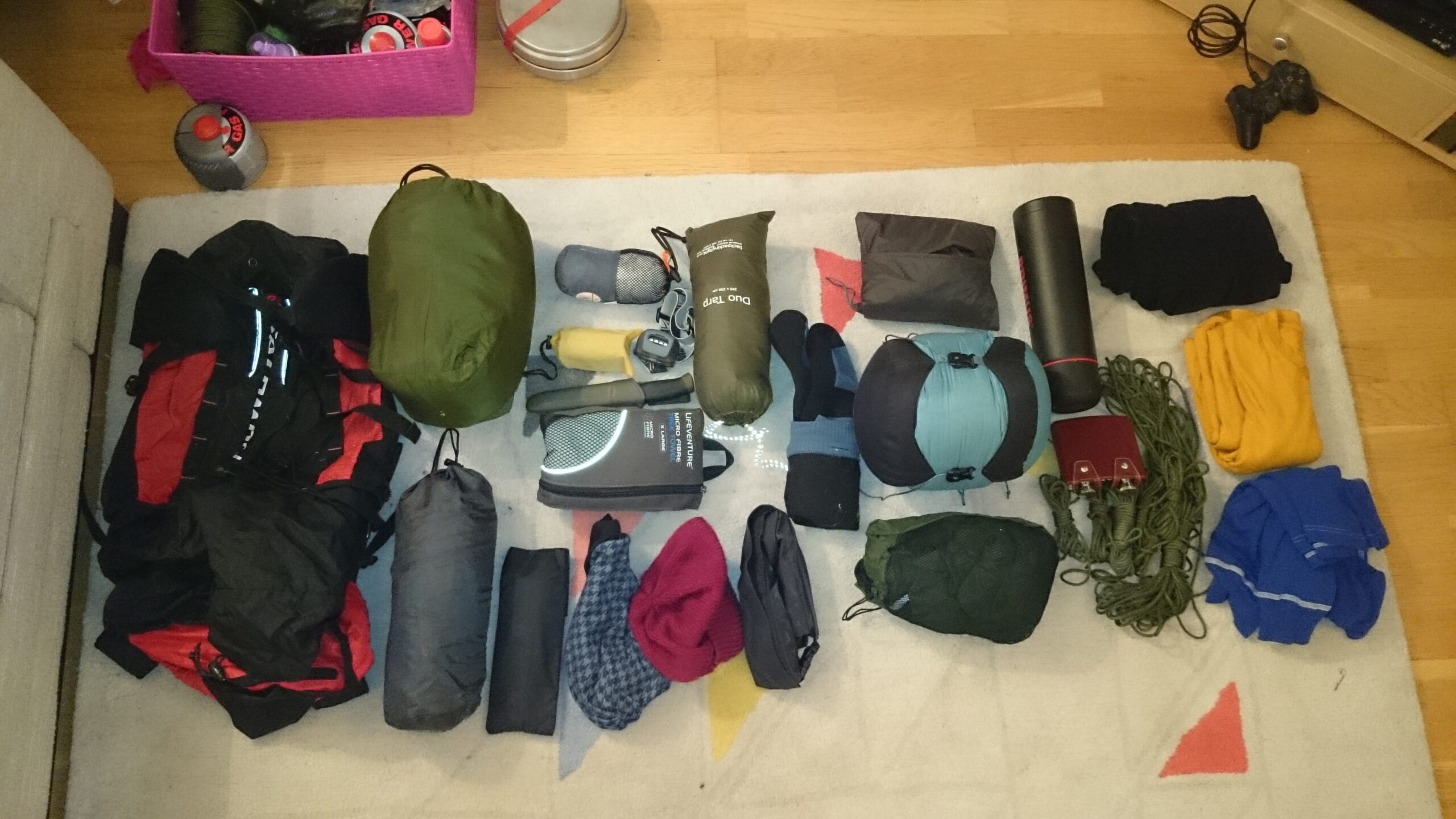
What I packed, might go through this in more detail in another post

Ready to go
Ready to go

So, I met up with Rob and Tad at Waterloo after work and we got the train down to Guildford with a couple of excited cans on the way. We then took a short walk from the station to the Kings Head pub for dinner and a couple more pints. In the cold weather it’s important to fuel the fire and fill up properly, and the Kings Head proved completely up to the task with large portions of burgers, pizza and chicken. (This article has some great tips on how to be as warm as possible in your bag.)

After dinner we took a short walk up to Pewley down (map here) to find a spot to make camp. This plan was pretty easy to come up with but I think I may finally have found the reason for Bing maps: planning microadventures. The combination of having OS maps available and the birds eye view makes it very useful for spotting potential wild camp areas, much more so than Google maps.

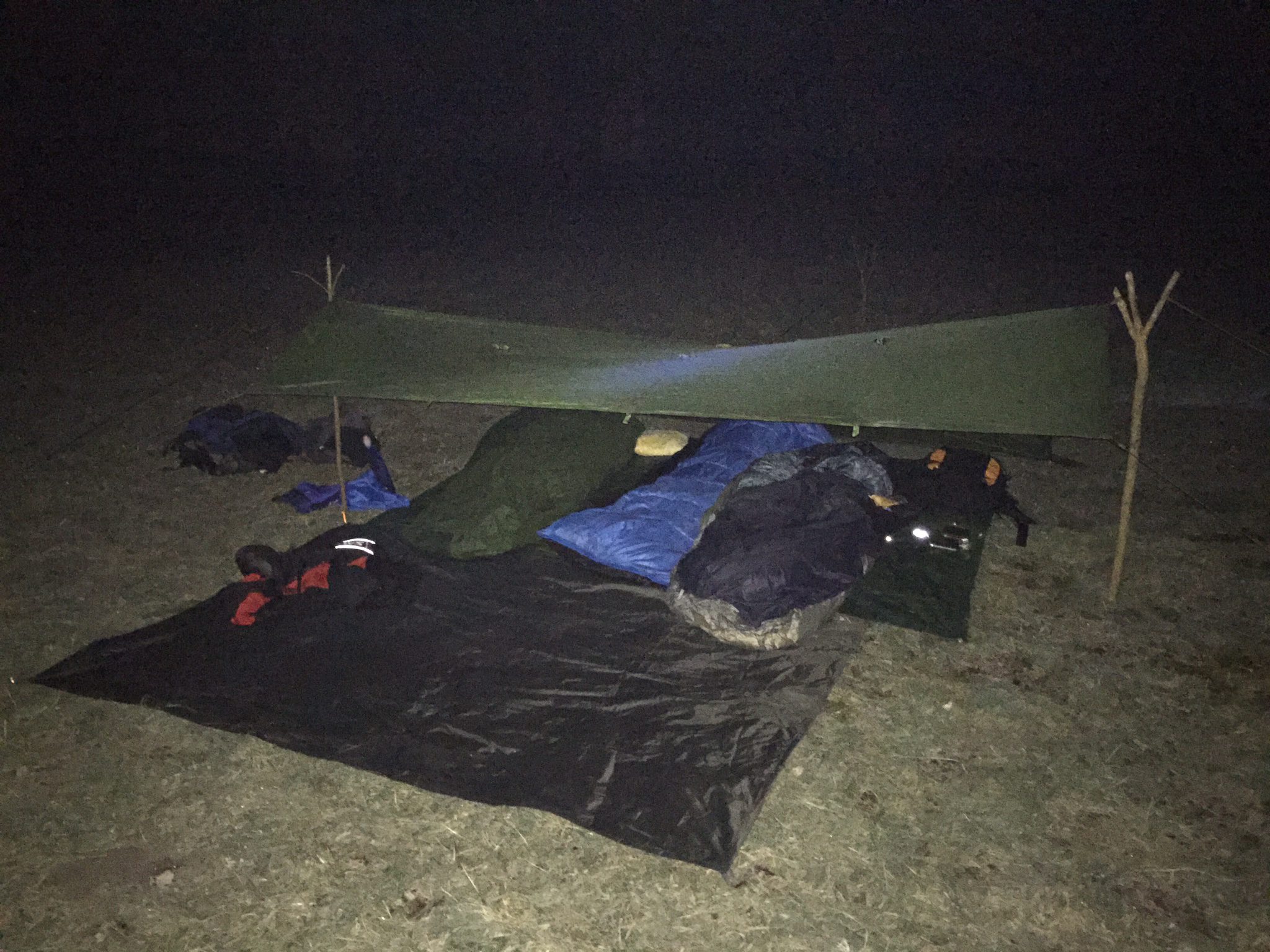
The hill was a lot steeper and higher than expected which was good news in that the views would be that much better. The first task was to collect some suitable sticks to use with the tarp. We had thought about just going with bivvy bags but Tad didn’t have one and we didn’t fancy waking up with our bags covered in frozen condensation so tarp was the only way. Finding sticks was very easy and I’m glad we didn’t bother bringing walking poles to use. After a bit of scouting round we found a flat spot with a good view and set up camp.

Camp complete with whisky drinking porch

Doing this in winter means that you can set up camp earlier and worry less about being discreet as there is no one else around. We saw one dog walker at around 6.20am who shone his torch at us but no one apart from that.

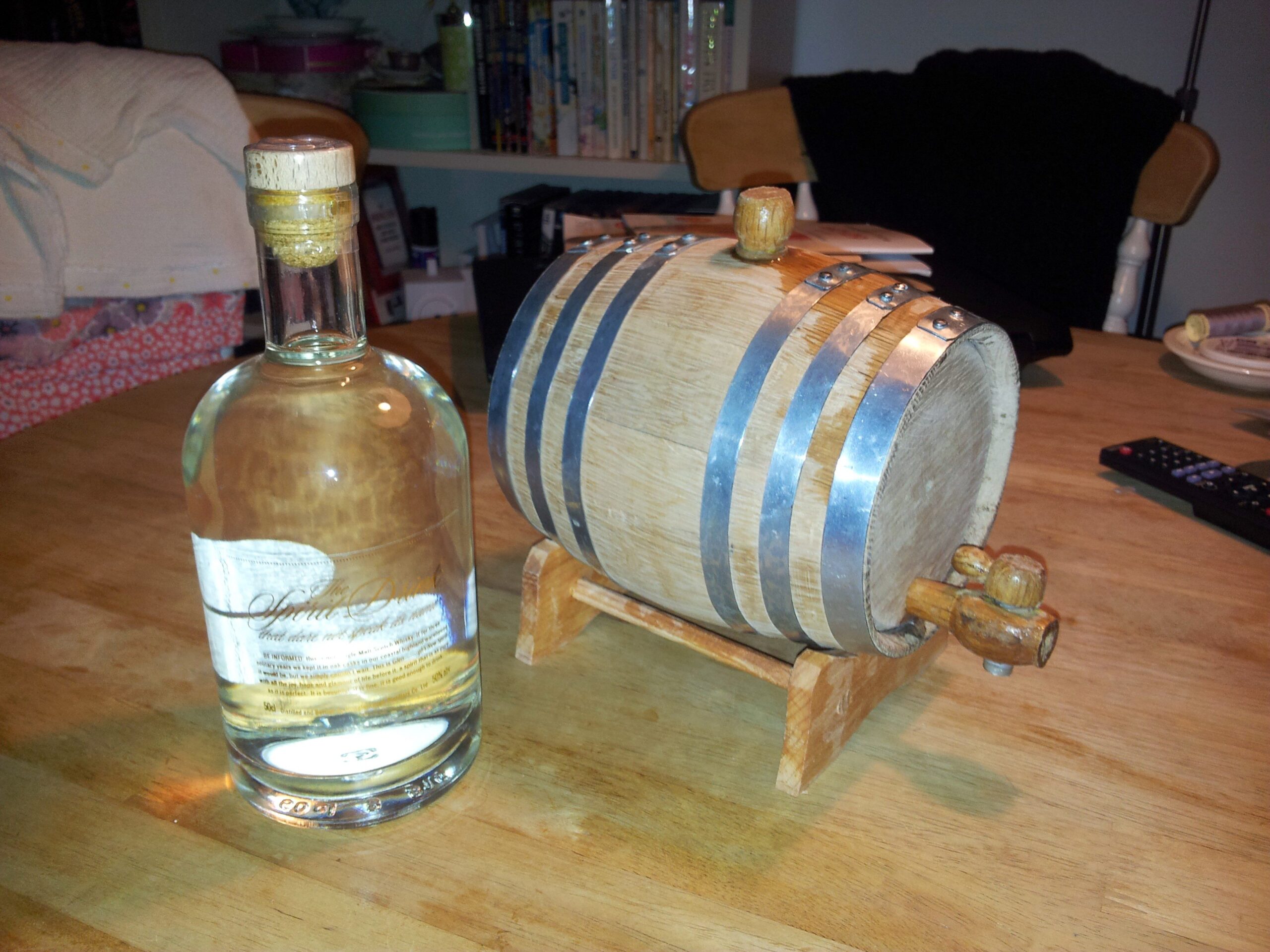
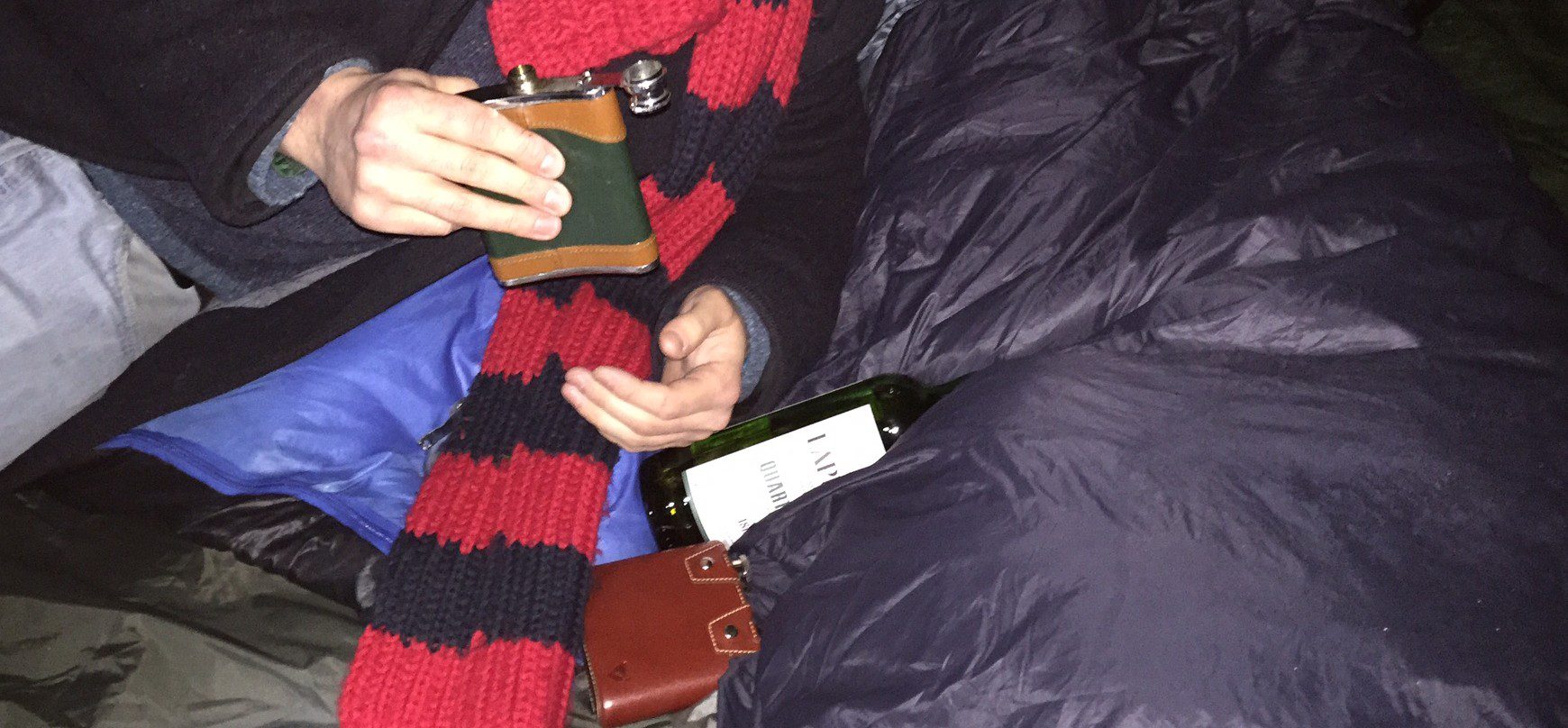
We then sat down to enjoy the outdoors and some whisky. Top marks here went to Tad for bringing a bottle of Laphroaig Quarter Cask – an excellent whisky. I had in my split hip flask some Ardbeg Uigeadail and some new make spirit from Glenglassaugh which I had aged for a month or so in a very small cask.

New spirit and mini cask

Rob had brought a couple of mystery choices that had been in hip flasks for a while, they all went down excellently.

Getting stuck in
Getting stuck in

After drinking a fair amount of whisky and realising we still had to go to work in the morning we got into our bags. It took a bit of sorting to get in and snug but I was then warm for the whole evening, wearing a lot of merino and sleeping in my silk liner inside my bag, inside my bivvy bag. I woke up a few times during the night but on the whole was warm and comfortable. Tad on the other hand had a worse night – doing this in -4 temperatures does need some more serious gear than what you can borrow from your girlfriend.

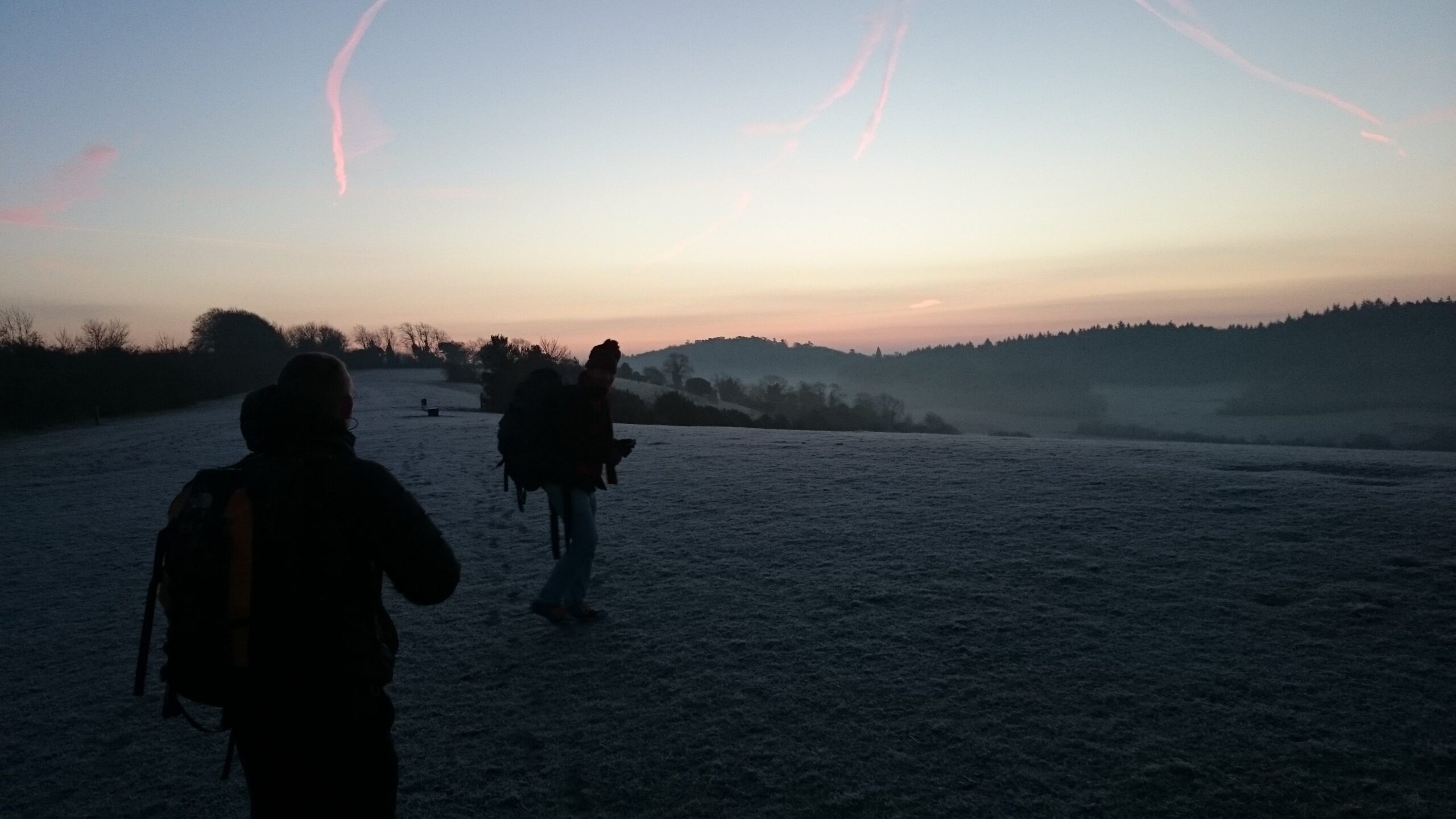
We got up about 6.40, packed up the gear, had some coffee from a flask prepared at work the previous day and headed to the station.

Stuff sacks seem to shrink overnight, or was it the ice on everything

This is why you do it

Heading back to civilisation

Train back to Waterloo, shower and change at work and then into meetings. I was pretty spaced out during the morning, not sure if that was due to sleeping out or the 5 pints and multiple whiskies. All in all this was a great success

What would I do differently next time?

  • Get a better pillow setup, it was a bit low and stopped me sleeping well on my side
  • Make sure I knew my knots before leaving
  • Take a different waterbottle or have it in my bag to stop it freezing overnight

Dartmoor Microadventure – legal wild camp

In the summer while we were down in Devon we took the opportunity to go for a microadventure in one of the only places in England where you can wild camp legally – Dartmoor. Amazingly in England and Wales (but not Scotland) it is illegal to wild camp pretty much everywhere, this site gives some good info. As it says on there, you can in practice get away with wild camping in lots of places where it is technically illegal, like Ditchling Beacon, but it’s great on Dartmoor to not have to worry at all about being discreet.

So we walked up during the afternoon (I can’t remember exactly where we parked or camped) and although we had grand plans about a big walk before pitching camp, pretty soon we got a bit tired and bored of walking and started looking for a place to pitch the tarp.

Thinking about not walking any more...
Thinking about not walking any more…

The weather was fantastic with amazing visibility although it was quite windy. So we went and found a flat spot with a hill behind us where we were a bit sheltered from the wind.

Lean to setup blocks wind from behind...
Lean to setup blocks wind from behind…

...while giving great views in front
…while giving great views in front

We’d picked up a stick from earlier in the walk to use as a lifter and set up the tarp in the same lean to way. We’d obviously got a bit out of practice on the knots though as I woke up during the night to the sound of one of the guylines flapping around and had to jump out of my bag to go and re-tie it. This was more difficult than it might have been as I had drunk a fair amount of wine and whisky before bed. I did though manage to catch sight of a fox who was sniffing round our camp.

We cooked a reasonable 2 course dinner of pasta and steamed pudding and then wrapped up to watch the stars and also the firework displays celebrating the various regattas along the coast. Seeing fireworks from above is quite strange but it was great being able to see them.

Don't have to be subtle when wild camping on Dartmoor
Don’t have to be subtle when wild camping on Dartmoor

Fairy lights threaded through the tarp attachment points make a great lightweight lighting solution.

The neighbourhood fox, during daylight

Catching sunrise is one of the biggest upsides of wild camping

I was surprised how cold it was overnight considering it was during summer. It was a completely clear night though and we were in a pretty exposed spot. Having said that I was very cosy in my sleeping bag and bivvy bag combo and just wore a t-shirt and boxer shorts to sleep. In the morning it took us a long time to get out of our bags because they were so snug, but we did get up, had a quick breakfast and walked back down to the car. Microadventures are great.

What would I do differently next time?

  • Take nicer food for dinner and focus the evening more on dinner than the walking
  • Tie the knots right first time
  • That’s about it

Matching Music to Board Games – King of Tokyo

Playing a board game is enhanced by having suitable music or background noise, making it a more immersive experience. In this series of posts I will provide some recommendations for music to go with particular board games.

null

First up is the game King of Tokyo. This is a fun game to play, pretty short and easy to pick up with a fun concept and great board design. The music recommendation for this is very straightforward and obvious: the original soundtrack to Godzilla by Akira Ifukube (Spotify link). Definitely not any of the soundtracks to the more recent films.

I genuinely enjoy the soundtrack in itself and it works perfectly with the game. Moving your piece into the city while the monster noises come through on the soundtrack is great.