A quick look at what I’ve been running, playing, and learning this month.
🏃 Running & Stats (30 days to 19 Dec)
Training Goal: sub-20m 5k by end of 2025 – attempt planned for 23rd before Christmas eating
Total Distance: 160 km
Elevation Gain: 1,931 m
Key Workout: 8 x 3min at 5km pace – hard!
How it felt: Not enjoying running along the road all the time, but needs must
🎲 Games + Music
On the Table:One Night Ultimate Werewolf – played with grandparents and kids, great fun once we’d worked it out. Fast and furious
On the Speakers:Darkness on the edge of Town – Springsteen – my highest rated album from the 1001 albums project. Also really enjoyed Jazz Samba by Stan Getz
The Verdict: Maybe these two could go together, but love the darkness in the Springsteen.
📚 Inputs (Books, Podcasts, Tools)
Reading:Children of Ash & Elm by Neil Price – Vikings were so weird, so metal, so unlike today’s civilisations even though the people were basically the same. Fascinating the different ways society can organise
Listening: Got round to listening to the Acquired episode on Google, great story although I wonder if they over-emphasise the importance of the individual
Cool Tool:ActualBudget – amazing personal budgeting software. Won’t appeal to everyone but a complete gamechanger for me. Will do a separate post on it
In June 2019 I sat and passed the B2 exam in French. According to the Common European Framework of Reference for Languages, this is a vantage or independent user level which should take about 600 hours of study to achieve.
Here is how I studied for this and the tools I used in case it is useful for someone else.
My starting point was that I had studied French at school until GCSE, ie until I was 16 (about 20 years ago). I’d got an A* in that exam but was frustrated when going to France that I still couldn’t really understand anyone or communicate. So I decided to try and improve my French level and the B2 level seemed achievable without actually living in France, but stretching enough to be worthwhile.
I was also trying to fit this work in around a full-time job and having young children at home. I had two hours of commuting to and from work each day, an hour on the bike and an hour on the train and this was my key study period. It’s definitely true that learning a language is not hard, it’s just long. Persistence and consistency are the key, and finding ways to fit the language learning into your daily life and routine. For me that meant using lots of audio, reading the kindle or watching French Netflix on the train.
Key Resources Used
My key resource was Anki and the flashcard techniques from Fluent Forever. Anki is magic. It’s just an amazing method for getting information into your brain and making it stay there. I made 2,400 French cards in the end and I can’t imagine trying to learn a foreign language without it. If this tool was around when I was at school my life would have been a lot easier.
Listening:
The key thing I learnt from Francais Authentique was that listening is a great way to improve your French (or any other language), but you need to be understanding at least 70% or so of what is being said. You should then listen to the same material over and over again, potentially consulting transcripts as well until you are understanding more like 90% of what is said. This can be pretty boring but it is also very effective. You should also enjoy and be interested in what you are listening to, which goes against the previous direction really…
This is a great set of podcasts and I also actually paid for some of the materials he produces. They were useful and improved my French for sure, but quite boring so I’m not sure I would do that again. Having the transcripts as well as the audio was handy though
Was very useful to just have the materials there though, so even when not feeling super motivated I always had the next lesson available and could keep pushing through.
Some great podcasts here, I can’t remember all the ones I listened to but a wide range of interesting stuff
Netflix in French (with or without subtitles)
In particular Call My Agent (Dix Pour Cent) and Marseilles
These are great to watch and didn’t feel like studying at all
Reading
The key tool for my reading practice was my Kindle – it is magic for reading in a foreign language for 2 reasons
It has an inbuilt dictionary so you can immediately look up any word you don’t know
Any word that you do look up is added to a list, so that you can go back and make a flashcard for it and learn it
I started out reading the Harry Potter stories in French, but I’ve never been a fan of those books and was not learning any particularly useful vocabulary. So I switched to reading the Inspector Maigret books which I really did enjoy. It can be difficult to find ebooks in French and I’m sure there are good deals out there I didn’t find
Speaking
The first thing is that listening to lots of French will improve your ability to speak, and your accent and fluency so just doing lots of listening practice improves your speaking anyway.
But my main speaking practice was through italki, where you can find people who will give you French lessons online for very reasonable prices, c. £15 / hour. This was great, I could find someone to fit in my schedule and do the classes from home and it worked really well. It is important with this to be clear with the tutor what you want from the lessons, and also don’t be afraid to change tutor if the one you have isn’t working out.
Writing
I didn’t do enough writing and this was reflected in my scores. The main resource I used was kwiziq. This is great for improving grammar and is really helpfully organised into the DELF levels so you can tick off everything you need at a particular level. In retrospect though, I should have done more actual practice of the sort of tasks you get in the exam
italki also allows you to submit pieces of writing which will be corrected by the community and I did this a few times.
There is a certain style of writing that you need to execute in the B2 exam, beyond just writing correct French and I didn’t practice this enough.
At Burns Night you have to drink whisky. Well, you don’t have to, but you don’t have to do anything really. I strongly recommend drinking whisky though, on Burns Night and on most other nights. But whisky is not a particularly accessible drink, and if you get your first few whisky experiences wrong then you’ll end up with a lifelong aversion to this magnificent spirit. Also there has been an explosion of interest in whisky in the last 5 years or so, meaning that supermarkets are carrying a much wider range and distilleries are producing a lot more varieties. Prices have also gone up, making buying whisky a bit more daunting for the beginner. So here is a quick guide for buying and drinking whisky for Burns Night, or any other night, or during the day because conventions and customs are just products of our imagination.
When drinking whisky, add water. Add as much water as you need so that it doesn’t burn your mouth and you can taste it properly. Don’t use ice or really cold water, cold things have less taste (hence why you keep vodka in the fridge and lager is best served cold) and you want to taste the whisky. You want it strong enough to be warming, but not burning. Don’t feel bad about doing this, unless you have bought a bottle at cask strength (c. 55% alcohol) then it’s already been watered down before being bottled. So add some water and get it to a level where you actually taste the stuff. Maybe in the future you’ll become accustomed to the burn and enjoy it, but for now add the water.
For your first whisky, get a good blend like Chivas Regal, Monkey Shoulder or Ballantines. Blends are designed to be smooth, with no one flavour predominating so are an excellent starting point into whisky. Don’t buy a litre bottle of Bells unless you’re very clear about what sort of night and following day you’re after.
Single malts are not necessarily better than blends but they are generally more expensive because at least half of a blended whisky will be grain whisky which is cheaper to produce and has a more neutral flavour. If you want to go for a single malt, then stay safe and get one of the glens like Glenlivet, Glenfiddich or Glenmorangie. These are all excellent whiskies from the main whisky area of Scotland around the River Spey. They are smooth, not too fruity and unpeated. Avoid anything that is finished in a wine cask or something like that, plenty of time for those later.
There are two main flavours of whisky and at some point you’re going to want to explore the wild outposts of peat. Whiskies from Islay taste like nothing else. They are made with barley that has been dried in peat smoke and taste smoky, salty and medicinal. The first time I had a Laphroaig (pronounced Laff-roy-g) I thought I’d accidentally licked an ashtray and I was still tasting it the next morning. It’s great whisky but try someone else’s before you decide to buy a bottle. Laphroaig and Ardbeg are probably the most commonly available Islay whiskies and the standard 10 year olds are great. If you can find the Laphroaig Quarter Cask then that’s slightly less peaty having picked up more wood flavour from the smaller cask – it’s excellent and great value.
(As a side note, Ardbeg Uigeadail and Corryvreckan are two of the last good deals you can get at duty-free. For £50-£60 you will struggle to buy better whisky. The standard Ardbeg is good but these are great.)
The other big flavour is sherry, which comes in when the whisky is aged in casks that used to hold sherry. Whiskies like Aberlour and Glendronach taste of dried fruit and Christmas pudding and smell fantastic, so go in for something like that if that appeals. To check how sherried a whisky is, just look at how red the liquid is in the bottle, the more colour it has the more sherry flavour it has picked up from the whisky (unless it’s a cheap whisky that has had colour added).
But whatever you do, add some water, smell it before you taste it and hold it in your mouth for a while. You won’t be drinking a lot of whisky, or at least you won’t remember drinking a lot of whisky so savour the drinks you do remember and think about what you’re drinking.
The Anatomy of a Successful Toast (A Data-Driven Approach)
I am not a natural public speaker. When I was asked to do this, I was terrified of either boring the room or accidentally offending someone. So, I did what I always do: I analyzed what makes a speech work and built a structure to minimize the risk of failure.
I looked quite extensively online for tips and example toasts but nothing was that good so, in the hope that it might help someone else out here’s the toast that I gave, or at least the toast that I wrote beforehand. I definitely didn’t read this out verbatim, I’d had a few beers and was feeling more creatively inspired in the delivery than when I wrote it – I recommend this approach!
If you are writing your own version, here is the 3-part formula I used:
1. The “Low-Status” Opener
The Goal: Lower expectations immediately. The biggest mistake people make is trying to be a stand-up comedian. You don’t need to be funny; you just need to be self-aware. By starting with a joke at my own expense (my lack of preparation, my nerves, or my Google search history), I got the audience on my side early. Once they are laughing with you (or at you), the pressure drops.
2. The Pivot to Sincerity
The Goal: Make people think, enjoy the contrast. A “Toast to the Lassies” is traditionally a roast, but if you stay in “roast mode” for 5 minutes, it gets awkward. You have to have some light and shade. If you are speaking in front of people, there is a chance to change how they think about something, and it’s worth taking that opportunity. So I made sure to have a sincere element. People then enjoy the jokes after more as well.
3. Closing and Call-backs
The Goal: Leave before they want you to, and tie things together. I timed this speech to be under 4 minutes. In the history of Burns Suppers, nobody has ever complained that a speech was “too short.” Maybe this is just me, but I really enjoy callbacks, referencing something that was mentioned earlier: Arrested Development is full of these, also Stewart Lee’s stand-up. It makes me think that the person has thought about this, and gives me an extra satisfaction .
Good evening Ladies and Gentlemen. For those who don’t know me my name is Rob Mitchell and I play second row for the 1st XV. I also compile the statistics for the 1st XV, noting how many appearances players have made, and so because I love statistics I note that this is the third Burns night I can remember attending here. Since my first appearance I’ve learnt not to wear a kilt to these occasions and John Hines has learnt not to ask me in front of assembled dignitaries to prove whether I am a true Scotsman in my wearing of said kilt…
So when David Dick asked me to give the Toast to the Lassies, I said I’d think about it but wasn’t sure if I could do it… he then thanked me for agreeing to do it and here we are. I have to confess that despite being born in Glasgow and with parents living in Aberdeen I had to go and look up what was expected from the Toast to the Lassies. My hopes were immediately dashed when I realised it had nothing to do with those incredible dogs who save so many children from abandoned mine shafts every year, or the Guildford RFC backline.
Scotland still being just part of Britain I went to the BBC site which describes the Toast to the Lassies as “the humorous highlight of any Burns Night”. I’m not sure who wrote that but no pressure I suppose… at least not if you’ve spent the rest of this evening sitting on Rory Andrews’s table.
The BBC goes on to say that this toast “is designed to praise the role of women in the world today. This should be done by selective quotation from Burns’s work and should build towards a positive note.” I don’t know if that means I should start on a negative note or something. However one important point that the BBC does not mention is that in preparation the speaker should spend 80min running round a muddy field getting his head kicked in, followed by 4 hours of aggressive drinking, but we can all read between the lines here.
Here at Guildford we are lucky to be able to count on the involvement of many women, from the players in the mighty Gazelles, to coaches, physios, administrators, volunteers, bar and catering staff and supporters. Not to mention those partners of players who put up with weekend disruption as Saturdays (or Sundays) are spent playing and then the rest of the weekend involves their partner lying around in pain and asking for back rubs. I’m glad and proud to be part of a club which has such an active involvement from the other 50% of the population.
So on to Robert Burns. He was a big fan of women but however not such a big fan of responsibility, commitment or the withdrawal method and is thought to have fathered somewhere between 12 and 16 children with at least 4 women before he died at the age of 37. For a fan of statistics such as myself the implications of that are pretty mind-boggling. Assuming that there were no twins, that’s 1 child every year since the age of 20.
I’ve never really read much Robert Burns but I started looking through his work to prepare some of those selective quotations that the BBC recommends and was struck by how alive a lot of those poems and songs felt. You can really get a sense of the person behind the writing and the 16 children by 4 women in 20 years seems less outlandish. I am no Burns scholar but reading some of this stuff and picturing the man behind it, it seemed like there were three types of writing that Burns did.
First up are those poems where Burns is delighting in his conquests and showing what a lad he is. This one is thought to be inspired by Elisabeth Paton, a servant girl who worked in the Burns household:
My girl she’s airy, she’s buxom and gay, Her breath is as sweet as the blossoms in May; A touch of her lips it ravishes quite. She’s always good natur’d, good humor’d, and free; She dances, she glances, she smiles with a glee; Her eyes are the lightenings of joy and delight: Her slender neck, her handsome waist, Her hair well buckl’d, her stays well lac’d, Her taper white leg with an et, and a, c, For her a, b, e, d, and her c, u, n, t, And Oh! For the joys of a long winter night!!!
The second type of verse has a long lineage and was all too easy for a rugby player to recognise. No doubt many here are familiar with the story of the man who used to have a retail job in Chicago but lost it due to many misunderstandings with female customers and the items they came into the store looking for. Or the joys of being a Rifle Ranger, or the bear that I know that you don’t know, and so on and so on. If you were in the vicinity of the A3 between Gosport and here this evening it’s possible you may have heard some of these stories set to music…
It’s impossible to read something like Coming through the Rye (chorus:
O gin a body meet a body, Comin’ throu the rye: Gin a body fuck a body, Need a body cry.)
Or the fantastically crude “Nine Inch will please a lady”:
`Come rede me, dame, come tell me, dame, `My dame come tell me truly, `What length o’ graith, when weel ca’d hame, `Will sair a woman duly?’
The carlin clew her wanton tail, Her wanton tail sae ready I learn’d a sang in Annandale, Nine inch will please a lady.
and not imagine Robert Burns and his mates getting pretty severely boozed before launching into drunken renditions of these and several others.
I’ve been a bit coarse here, and it’s not gone down as well as I’d hoped, so the BBC says that this toast should build towards a positive note (John Hines might be wishing that he’d asked me to prove my Scots heritage instead now…) I’d like to look at the final category of Burns’s work, those poems which go furthest to explain the multitude of women he was involved with. It is easy to imagine the average standard of wooing from farmers in 18th Century Ayrshire and then compare the stuff that Burns was coming up with. Maybe there were a load of outstanding poets back then, but much like playing for Guildford before I started recording statistics – if no-one records it then did it even happen? So imagine the success that someone would have with verses like these from “O Saw ye Bonie Lesley”.
To see her is to love her, And love but her for ever; For Nature made her what she is And never made anither.
Thou art a queen, fair Lesley, Thy subjects we, before thee: Thou art divine, fair Lesley, The hearts o’ men adore thee.
So to conclude, would you please be upstanding and I’d like to finish with some final words from Burns as we toast to the lassies:
Old Nature swears, the lovely dears Her noblest work she classes, O: Her prentice hand she tried on man, And then she made the lassies, O.
If you’re looking for some whiskies, have a look at this other post:
I’ve been riding my Brompton for about 7 years now, commuting to and from work about 25min each way. I’ve also done a few longer trips with it including a trip from London to Aberdeen, riding about 60 miles each day. So I think I’ve put some pretty serious mileage on it and have learnt a bit about what on it is good and what can be improved.
When I bought it, my Brompton was an M6L. That is it had the classic U shaped handlebars, 6 gears and lights and a rear rack. The lights were the bottle dynamo type, powered by a small wheel rubbing against the rear tyre and that was the first thing I got rid of. I didn’t really want the L type but I needed to get the bike in a bit of a rush (before the Scotland trip) and that was what was available at a reasonable price. The bottle dynamo is a waste of time, so much so that I think it has been discontinued. It would often flick on when going over a bump and seemed to make cycling a lot harder. LED lights are cheap and the batteries last a long time so they are a much better option.
Having said that, one good thing about the dynamo light is that the front light is mounted down near the wheel and is not obstructed by any luggage you might have. When using handlebar lights in conjunction with a large bag, the bag can obstruct the light, meaning that there is a shadow about 9 feet in front of you.
As mentioned above, LED lights are cheap so I have several on my bike. I keep a couple of Electron Backupz on for emergencies and as my main lights I have a Cateye Nanoshot on the front and the Moon Gem 3.0 on the back. Both of these are USB rechargeable which is essential for a commuter and the Nanoshot is bright enough to illuminate a dark road. I’ve had them for a couple of years and they are both great.
Another major improvement I’ve made is swapping out the basic foam grips for some Ergon GP3 grips. I cannot recommend these enough and Brompton should be offering them as an option. You have to cut them down to get them to fit (and it helps if you have the 2014 brake levers with the narrower bracket) but they will fit and not interfere with the fold, at least if you have the rack. They are incredibly comfortable and I can’t imagine going back to something else. On the trip to Scotland, my hands probably suffered more than anything and I wish I had had these then.
I was so impressed with the grips that I went back to Ergon for some pedals and got a pair of their PC2s. I only actually use the right pedal as I keep the folding one on the left but you can’t buy just one pedal… The main benefit of these is that they are flat – I found the standard Brompton pedal could tear up my shoe a fair bit, the problem is less on the folding pedal as the spindle area is larger.
This one might seem minor but has made a difference: a metal chain guard from Tiller Cycles. I was having issues with my plastic one coming loose, falling off and cracking so after seeing these on My Orange Brompton I bought one, and again it’s great. Makes the bike look better and I never worry about knocking it loose with my shoe.
Other changes I’ve made have mainly been to take advantage of the development that Brompton is doing. One of the best things about Brompton is that you can buy every individual part should you so wish so it is easy to upgrade and replace items. So over the years I have…
Swapped the standard tyres for Marathon plus on the back and Kojak on the front, then just Marathon plus on both as punctures are a real pain. The old Marathon plus seems to be better than the new one…
Upgraded the brake levers to the ones Brompton brought out in 2013-14. These are much much better
Upgraded the hub to the wide range version. To be honest I didn’t notice much difference with this and probably wouldn’t bother again. You don’t need as many gears as you think
When I got the new hub on, I had a new style rim put on as well. I’m pretty heavy and I kept breaking spokes on the rear wheel but since having the new rim (which is meant to have more sympathetic angles for the spokes) I haven’t had any problems
Replacement rear triangle when the bike shop spotted a crack in it, this Brompton replaced for free (credit to Simpsons Cycles for spotting the issue)
Added the EZ wheels to the rear rack. Again these are much better than the standard ones
Bromptons are fantastic machines, but they can be improved. If you do one thing to yours put the Ergon grips on. It is very easy to do and a step change in comfort when cycling, especially if you are like me and have the seat above the level of the handlebars, resulting in a lot of weight going through your hands and wrists.
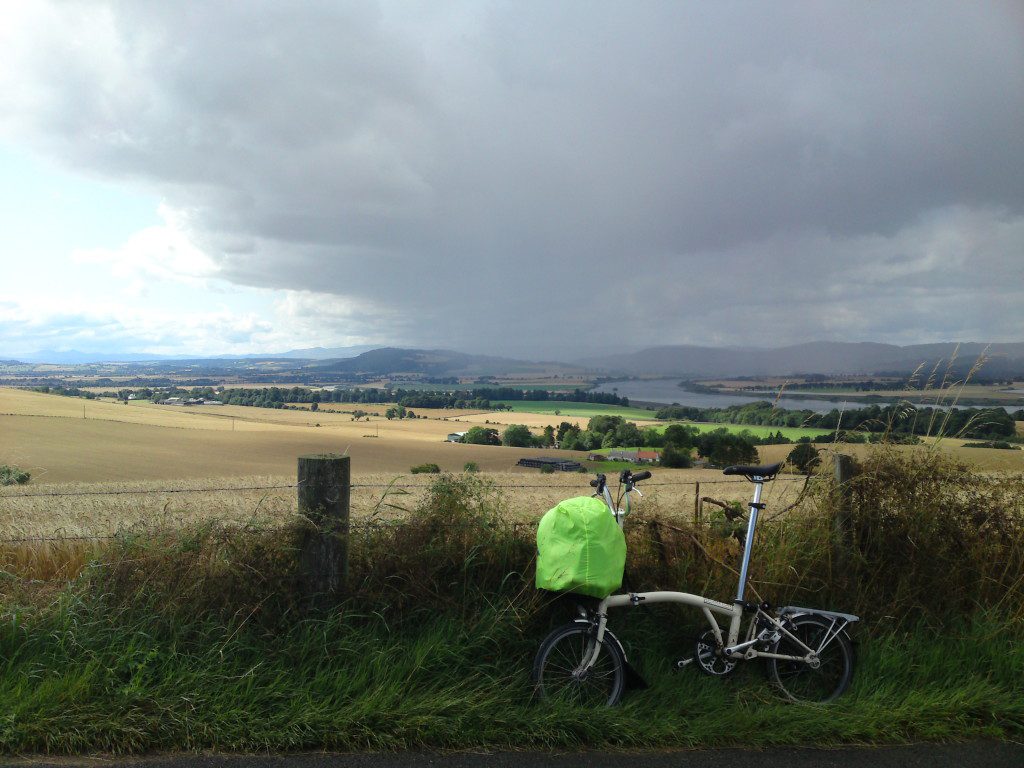
Coming up to Dundee I think – before I replaced the grips (or much else)
I find the thought experiment in this video completely convincing and am immediately guilty. Amazing the sort of mental gymnastics I go through though to maintain my conception of myself as a basically good person, while not doing more to help others. See previous entry You Are Not So Smart for more on that.
Mackerel is incredibly easy to catch from a small boat using a handline, and tastes amazing. It is basically throwing itself at you. We caught 12 in about 20min, bbq’d them a few hours later and they were the tastiest fish I’ve ever eaten. Don’t think I’ll ever pay for it in a restaurant again. Recipe is: catch mackerel, cut off head and gut it, roughly fillet it, add some salt and pepper and apply to fire for a few minutes.